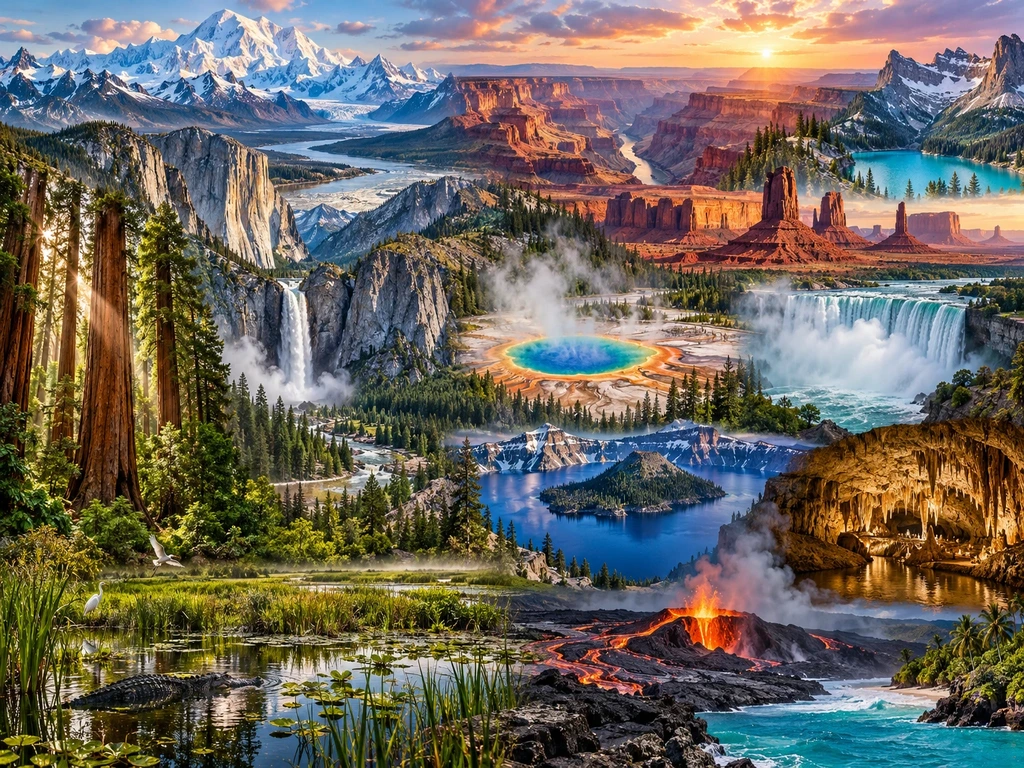
12 Must-See Natural Wonders in the US for Your Travel Bucket List
From a canyon nearly a mile deep to a cave system stretching hundreds of miles beneath Kentucky, the natural wonders in the US cover an extraordinary range of landscapes. You can find enormous waterfalls in New York, active volcanoes in Hawaii, ancient forests in California, glacial valleys in Montana, and one of North America’s highest peaks in Alaska.
There is no official government ranking of the country’s “natural wonders.” The National Park Service’s National Natural Landmarks program recognizes hundreds of nationally significant geological and ecological sites, while other places have gained worldwide recognition through UNESCO or popular travel traditions. This guide takes a broader editorial approach, considering landscape scale, uniqueness, geological importance, ecological value and the experience each destination offers travelers.
For a wider perspective beyond the United States, our guide to the seven natural wonders of the world looks at landscapes chosen on a global scale.
Natural Wonders in the US at a Glance
| Natural Wonder | State/Region | Best Known For |
|---|---|---|
| Grand Canyon | Arizona | Immense canyon carved by the Colorado River |
| Yellowstone National Park | Wyoming, Montana and Idaho | Geysers and hydrothermal landscapes |
| Yosemite Valley | California | Granite cliffs and waterfalls |
| Niagara Falls | New York | Huge volume of falling water |
| Denali | Alaska | North America’s highest mountain |
| Everglades | Florida | Vast subtropical wetland ecosystem |
| Hawaiʻi Volcanoes National Park | Hawaii | Active volcanic landscapes |
| Monument Valley | Arizona and Utah border | Massive sandstone buttes |
| Redwood National and State Parks | California | The tallest trees on Earth |
| Crater Lake | Oregon | Deep blue volcanic lake |
| Mammoth Cave | Kentucky | World’s longest known cave system |
| Glacier National Park | Montana | Glacial mountains, valleys and alpine scenery |
Many of these landscapes are found in states already celebrated for dramatic scenery, from Alaska and Arizona to California, Hawaii and Montana.
How We Curate This Guide
Shanzaib Haider researched and selected the natural wonders in this guide using official park and destination sources, geographic and geological significance, ecological value, landscape diversity, and the experience each place offers travelers. UNESCO designations and other recognized measures of natural importance were considered where relevant, but popularity alone was not enough to make the list.
The Wanderlust Craze editorial team reviewed the final selection and supporting facts to make sure the guide represents a varied cross-section of American landscapes, rather than simply ranking the country’s most famous national parks.
You can read more about how Wanderlust Craze researches, selects, and reviews its travel guides .
12 Natural Wonders in the US
1. Grand Canyon, Arizona
The Grand Canyon cuts through northern Arizona along the Colorado River and remains one of the most recognizable American natural landmarks. Its extraordinary scale comes from the combination of depth, width and exposed rock layers, which reveal a long record of geological change. The canyon reaches about a mile in depth and stretches for 277 river miles within the national park.
Seeing the Grand Canyon in person is one of those travel experiences that is difficult to fully appreciate from photographs. The first glimpse from the rim feels almost unreal, particularly when the morning light starts picking out the canyon’s layers.
The South Rim offers the easiest first visit, with viewpoints accessible along the canyon edge. For a closer look, follow the rim trail or take a shuttle along Hermit Road to its sequence of overlooks.
2. Yellowstone National Park, Wyoming, Montana and Idaho
Yellowstone feels unlike almost anywhere else in the country because its scenery is powered by intense geothermal activity beneath the surface. The park contains more than 10,000 hydrothermal features, including over 500 geysers, along with hot springs, mudpots and fumaroles.
For travelers who like landscapes with a sense of drama, Yellowstone may be the closest thing to a living natural theater. Steam rises from the ground, hot springs shift through vivid colors, and the landscape can change completely from one stop to the next.
The landscape also includes Yellowstone Lake, waterfalls, forests and broad mountain valleys. For a first visit, spend time around the Upper Geyser Basin and Grand Prismatic Spring, where boardwalks bring visitors close to the geothermal features while keeping them on designated routes.
3. Yosemite Valley, California
Few American landscapes have the visual drama of Yosemite Valley. Glaciers carved and widened the valley through the Sierra Nevada’s granite, leaving behind sheer walls, domes and waterfalls that have become symbols of California’s mountain country.
Yosemite Falls drops 2,425 feet, making it one of North America’s tallest waterfalls. Spring is usually the prime period for seeing the falls at their strongest, when snowmelt feeds the streams. Yosemite has the rare ability to make even experienced travelers stop talking for a moment. The granite walls feel enormous from the valley floor, and the surrounding scenery has a scale that rewards simply slowing down and looking around.
A drive to Tunnel View gives first-time visitors a sweeping introduction, while walks through the valley provide a much closer feel for its scale.
4. Niagara Falls, New York
At the US-Canada border, Niagara Falls combines dramatic height with an enormous flow of water. The group consists of American Falls, Bridal Veil Falls and Horseshoe Falls, with the American Falls located entirely on the US side. During peak water flow, roughly 750,000 gallons of water can pass over Niagara Falls every second.
That sheer volume gives Niagara its distinctive character. Visitors can take a Maid of the Mist boat ride for a close encounter with the rushing water, or explore Niagara Falls State Park and the gorge from land.
5. Denali, Alaska
Denali offers a very different kind of spectacle across a wild terrain. This national park and preserve covers about six million acres, with taiga forests and tundra leading toward the Alaska Range and North America’s highest peak, Mount McKinley, widely known as Denali, at 20,310 feet.
The road network reaches only a small part of the park, so visitors often experience Denali through the park bus system. A summer bus journey gives travelers the chance to watch the landscape change while looking for wildlife and clear views of the mountain.
6. Everglades, Florida
The Everglades proves that a natural wonder need not rise into the sky. This enormous wetland in southern Florida covers about 1.5 million acres within Everglades National Park, protecting freshwater marshes, forests and marine habitats. The park supports species such as American crocodiles, manatees and Florida panthers.
Its character changes with the seasons. The drier months, generally December through April, bring better conditions for viewing many wading birds and other wildlife. Canoeing, kayaking and guided water-based trips offer a better sense of how this unusual ecosystem works than a quick roadside stop.
7. Hawaiʻi Volcanoes National Park, Hawaii
On the Island of Hawaiʻi, Hawaiʻi Volcanoes National Park places visitors in a landscape still being shaped by volcanic activity. Kīlauea, one of the world’s most active volcanoes, has covered almost 90% of its surface with lava flows during the past 1,000 years.
The park combines volcanic craters, lava fields, coastal terrain and rainforest within a relatively compact area. Crater Rim Drive and Chain of Craters Road provide access to major viewpoints, while official eruption-viewing areas can offer striking scenes when activity is visible. Conditions around active volcanic areas change quickly, so visitors should follow current park closures and safety guidance.
8. Monument Valley, Arizona and Utah
Monument Valley sits right on the border between Arizona and Utah, and its giant red sandstone formations are some of the most famous sights in the American Southwest. Inside the tribal park, these massive rock towers and flat-topped hills shoot anywhere from 400 to 1,000 feet straight up into the desert sky.
Because this land belongs to the Navajo Nation, visiting with respect for local rules and guidelines makes the whole trip far more meaningful. While you can drive the main public loop on your own, booking a tour with a local Navajo guide gets you into restricted areas of the park and gives you a much richer look into the history, culture, and deep personal meaning behind the landscape.
9. Redwood National and State Parks, California
Walking beneath the coast redwoods of northern California can make ordinary measurements feel almost meaningless. These trees are the tallest living trees on Earth, with the tallest known redwood reaching about 379 feet. Some coast redwoods can also live for up to 2,000 years.
This is one of the rare places where the journey itself feels like part of the attraction. Roads disappear into dark green forest, enormous trunks rise overhead, and the quiet gives the whole landscape an almost ancient atmosphere.
The parks stretch from old-growth forests to Pacific coastline, so the experience goes beyond tree viewing. California has several landscapes with this kind of range, which is why it features so prominently among the most beautiful places in California. Newton B. Drury Scenic Parkway passes through towering redwoods, while trails around places such as Stout Grove offer a slower way to appreciate the forest.
10. Crater Lake, Oregon
Crater Lake occupies the caldera of Mount Mazama in southern Oregon, creating one of the most striking lake landscapes in the United States. At 1,943 feet deep, it is the deepest lake in the country and one of the deepest lakes on Earth. Oregon doesn’t hold the record for the most lakes in a state, but Crater Lake easily makes up for quantity with its unmatched depth and visual impact.
Fed purely by rain and snow, it ranks among the cleanest lakes on Earth, displaying an intense cobalt hue created by exceptional water clarity. Rim viewpoints provide the easiest way to appreciate the scale, while the drive around the caldera reveals changing perspectives of the water and Wizard Island. The Cleetwood Cove Trail provides the only legal and safe access down to the lakeshore for swimming.
11. Mammoth Cave, Kentucky
Beneath the forests of Kentucky lies Mammoth Cave, the world’s longest known cave system. The National Park Service recorded more than 426 miles of surveyed passages, with new discoveries and mapping work continuing over time.
The underground landscape contains enormous chambers, narrow passages and unusual cave formations, while the surface includes forest, river valleys and limestone country. A ranger-led cave tour is the key experience here because it reveals parts of the underground system that visitors cannot understand from the surface alone. Mammoth Cave is also one of the standout things to do in Kentucky for travelers interested in outdoor adventure. Tour options vary by season, with both accessible and more demanding routes available.
12. Glacier National Park, Montana
Glacier National Park brings together rugged peaks, alpine valleys, lakes and remnants of the glaciers that carved much of its scenery. The park has more than 700 miles of trails, giving travelers access to both easy walks and demanding backcountry routes.
Going-to-the-Sun Road provides one of the most memorable ways to cross the landscape. The 50-mile route climbs to Logan Pass at 6,646 feet, passing through glacially shaped valleys and high mountain terrain along the way. For a quieter experience, trails around Lake McDonald offer another perspective on how glaciers sculpted the park.
More Must-See Natural Wonders in the US
The list can easily grow beyond these 12. Arches National Park in Utah is packed with massive sandstone arches, while nearby Bryce Canyon is famous for its vast fields of spiky rock towers called hoodoos. Down in Arizona, Antelope Canyon features swirling, water-carved slot canyons that draw photographers from everywhere.
Heading west, Death Valley spans California and Nevada with stark, scorching desert basins. Up in the Sierra Nevada mountains along that same state line, Lake Tahoe offers a completely different vibe with its deep, crystal-clear alpine waters.
Mount Rainier dominates the Washington skyline with its massive glaciated peak, and Acadia National Park brings rocky Atlantic coastline to Maine.
In New Mexico, Carlsbad Caverns adds another remarkable underground landscape to the collection. Together, these destinations make the wider Wonders collection useful for travelers planning trips around very different American landscapes.
FAQs About Natural Wonders in the US
The answer depends on the landscape you want to experience. The Grand Canyon offers huge geological scale, Yellowstone is exceptional for geothermal activity, Yosemite combines granite scenery with waterfalls, while Denali delivers an enormous mountain wilderness. The 12 destinations in this guide provide a broad starting point rather than a formal ranking.
The Grand Canyon is arguably the country’s best-known natural landmark and receives worldwide recognition for its size, geological exposure and visual impact. The National Park Service describes it as one of the most spectacular examples of erosion on Earth.
There is no government-created list called the “official natural wonders of the United States.” The federal government does operate the National Natural Landmarks Program, which currently recognizes 606 significant natural sites across the United States and its territories.
The Grand Canyon has long been described as one of the “Seven Wonders of the Natural World,” including by the National Park Service. It was also a finalist in the 2011 New7Wonders of Nature campaign. The final seven selected by that campaign were Amazon, Ha Long Bay, Iguazu Falls, Jeju Island, Komodo, Puerto Princesa Underground River and Table Mountain, so the Grand Canyon was a finalist rather than one of the final seven.