Are There 50 or 52 States in the USA? Here’s the Real Answer
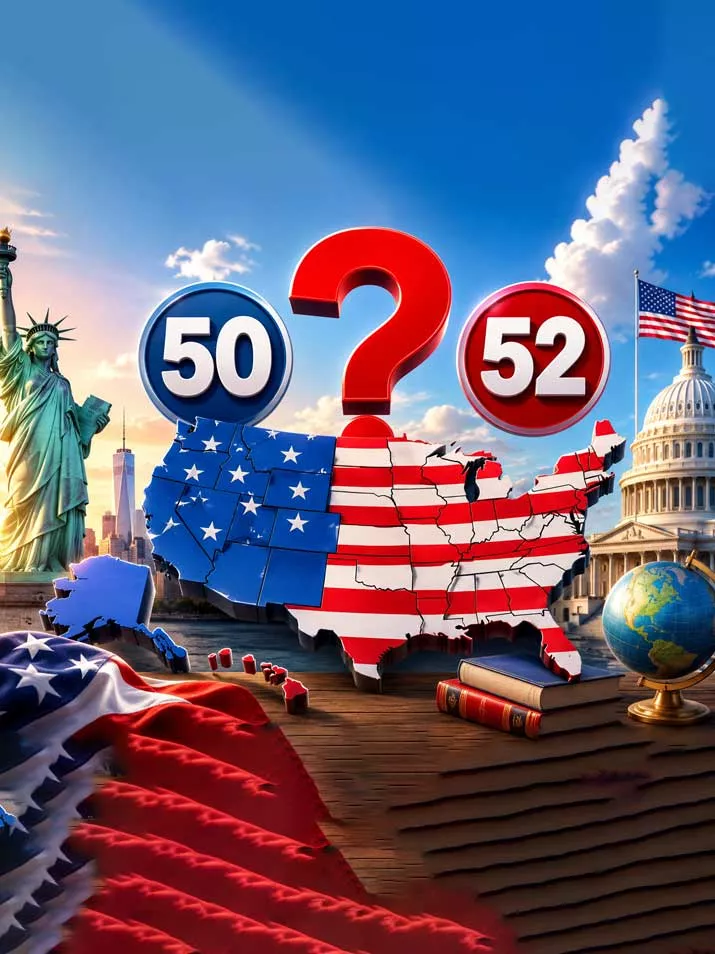
The United States has 50 states, not 52. The “52 states” confusion usually happens when people add Washington, D.C. and Puerto Rico to the official count, even though D.C. is a federal district and Puerto Rico is a U.S. territory.
That is why the question keeps coming back in classrooms, travel planning, trivia games, and online searches. The official answer is simple, but the U.S. map includes more than just states. It also includes a capital district, territories, island areas, and places closely connected to America without being states.
This guide focuses on the 50 vs. 52 states confusion. For the full official count, state list, and broader map context, see our complete guide on how many states are in the U.S.
Quick Answer: Are There 50 or 52 States in the USA?
The United States has 50 states, not 52. The “52 states” idea usually comes from adding Washington, D.C. and Puerto Rico to the count. D.C. is a federal district, while Puerto Rico is a U.S. territory. Alaska became the 49th state on January 3, 1959, and Hawaii became the 50th state on August 21, 1959.
The Real Answer: 50 States
America’s official state count is 50. That number has not changed since August 21, 1959, when Hawaii became the 50th state. Alaska had joined the Union earlier that same year, on January 3, 1959, as the 49th state.
The confusion begins when people treat every U.S.-connected place as a state. Washington, D.C. feels central because it is the capital. Puerto Rico feels closely tied because people born there are U.S. citizens and U.S. travelers can visit without a passport. But neither one is a state.
That is the split: The United States has 50 states, not 52. Washington, D.C., and Puerto Rico are often mistakenly counted, but neither is a state. A complete list of all 50 states and capitals shows each official state with its capital city in alphabetical order.
At a Glance: Why the USA Has 50 States, Not 52
| Question | Answer |
|---|---|
| Official number of U.S. states | 50 |
| Why do some people say 52? | They add Washington, D.C. and Puerto Rico |
| Is Washington, D.C. a state? | No, it is a federal district |
| Is Puerto Rico a state? | No, it is a U.S. territory |
| The last two states added | Alaska and Hawaii in 1959 |
| Does the U.S. flag have 52 stars? | No, it has 50 stars |
Why Do People Think There Are 52 States?
The “52 states” idea does not come from one single mistake. It usually comes from a few different misunderstandings stacking on top of each other.
Most of the time, people add Washington, D.C. and Puerto Rico to the official 50 states. Others get confused by the phrase “48 contiguous states,” then try to add Alaska and Hawaii. Some simply remember being taught the wrong number, or hearing it repeated enough times that it starts to sound familiar.
Here is where the confusion usually begins.
1. Washington, D.C. Gets Mistaken for a State
Washington, D.C., officially the District of Columbia, is the capital of the United States. It is home to the White House, Congress, the Supreme Court, the National Mall, and many of the country’s most visited landmarks.
But Washington, D.C. is not a state.
It is a federal district. That means it sits in a separate legal category from the 50 states. D.C. residents can vote in presidential elections, but the district does not have the same full voting representation in Congress that states do.
That unusual setup is one reason people get confused. D.C. feels like one of the most important places in America, because it is. But legally, it does not count as one of the 50 states.
If someone adds D.C. to the 50 states, they get 51.
2. Puerto Rico Gets Counted as a State
Puerto Rico is another major reason people land on 52.
Puerto Rico is a U.S. territory in the Caribbean. People born in Puerto Rico are U.S. citizens, and U.S. citizens can travel there from the mainland without a passport. Places like San Juan, El Yunque, Vieques, and Culebra also make it feel like a familiar part of the American travel map.
But Puerto Rico is not a state.
Puerto Rico does not vote in U.S. presidential elections the same way states do, and it does not have full voting representation in Congress. It has a different political status as a U.S. territory.
That is why the confusion makes sense. Puerto Rico is closely connected to the United States, but it is not part of the Union as a state.
When people add both Washington, D.C. and Puerto Rico to the 50 states, they arrive at 52.
3. The “48 Contiguous States” Adds Another Layer
You may have heard the phrase “48 contiguous states.” It refers to the connected mainland states, excluding Alaska and Hawaii.
Here is the clean distinction:
- 48 contiguous states: the connected mainland states
- 49th state: Alaska
- 50th state: Hawaii
- Total U.S. states: 50
So “48 contiguous states” does not mean the country has 48 states today. It simply means Alaska and Hawaii are not physically connected to the mainland states.
4. Some People Remember the Wrong Number
There is also a memory side to this question. Some people genuinely remember hearing “52 states” in school or in conversation. That does not make it true, but it does explain why the myth keeps spreading.
Some people connect this to the Mandela Effect, where groups of people share the same false memory. In this case, the mistake feels believable because the U.S. has states, territories, D.C., and the phrase “48 contiguous states” all in the same conversation.
Once those ideas get mixed together, 52 starts to sound possible, even though the official number has stayed at 50 since 1959. In fact, it is one of the most common geographic misconceptions on any list of fun facts about the US.
States, Territories, and D.C.: What Is the Difference?
The easiest way to understand this is to stop treating every U.S.-connected place as the same kind of place.
A state is a full part of the Union. It sends voting members to Congress, takes part in presidential elections, and gets one star on the U.S. flag.
A territory is different. It is under U.S. authority, but it has not been admitted as a state. That means its residents may have different voting rights, tax rules, and representation in Washington.
Washington, D.C. sits in its own category. It is the national capital and a federal district, not a state and not the same kind of territory as Puerto Rico or Guam.
Once those three categories are separated, the 50-state answer becomes much easier to understand.
What Are the Main U.S. Territories?
The United States governs several territories that are not states. The five main inhabited U.S. territories are:
| Territory | Capital | Residents are |
|---|---|---|
| Puerto Rico | San Juan | U.S. citizens |
| Guam | Hagåtña | U.S. citizens |
| U.S. Virgin Islands | Charlotte Amalie | U.S. citizens |
| Northern Mariana Islands | Saipan | U.S. citizens |
| American Samoa | Pago Pago | U.S. nationals, not automatic U.S. citizens |
American Samoa is the main exception in this table. According to the U.S. Department of the Interior, people born there are U.S. nationals, not automatic U.S. citizens.
None of these territories are counted as states. They may be part of the U.S. political and travel world, but they do not add stars to the flag and they do not change the state count.
Could Washington, D.C. Become a State?
Washington, D.C. has a real statehood movement, but it is not a state today.
The debate has been active for years. Supporters argue that D.C. residents pay federal taxes and serve in the military without full voting representation in Congress. Opponents argue that the national capital should remain separate from any state.
For now, the practical answer is simple: Washington, D.C. is a federal district, not the 51st state.
Could Puerto Rico Become a State?
Puerto Rico has held several votes on its political status, and statehood remains one of the island’s biggest political debates.
Still, those votes do not automatically make Puerto Rico a state. Under the U.S. Constitution, Congress has the power to admit new states. Until Congress acts, Puerto Rico remains a U.S. territory.
That is why Puerto Rico keeps the 50 vs. 52 states question alive. It is closely connected to the United States, but it has not been admitted as a state.
How the USA Reached 50 States
The United States began with 13 original states after the colonies declared independence in 1776. Over time, new states joined through expansion, purchases, treaties, and admissions to the Union.
A few key moments explain the modern count:
- 1776: The original 13 colonies declared independence.
- 1803: The Louisiana Purchase expanded the country westward.
- 1845: Texas joined the Union.
- 1867: The U.S. purchased Alaska from Russia.
- 1959: Alaska and Hawaii became the 49th and 50th states.
That history is part of why the U.S. feels so geographically varied today. The same map that explains 50 states also explains why travelers find such different landscapes across the country, from island chains and desert basins to national parks, coastal routes, clear lakes, and some of the most beautiful mountains in the U.S.
Why the U.S. Flag Has 50 Stars
The U.S. flag is one of the easiest ways to remember the answer.
It has 50 stars, and each star represents one state. The 13 stripes represent the original 13 colonies.
After Hawaii became the 50th state in 1959, the 50-star flag officially began on July 4, 1960. So if someone says there are 52 states, the flag gives the simple answer: there are 50 stars because there are 50 states.
What This Means for Travelers
If you are trying to visit every U.S. state, your list has 50 stops, not 52. Alaska and Hawaii count, but Washington, D.C. and Puerto Rico do not.
For most travelers, the 50-state count is only the first layer. Once the number is clear, the map starts to feel less like a checklist and more like a set of choices: which coast to explore, which mountain town to pause in, which lake to drive toward, and which of America’s most beautiful states deserves a place near the top of the trip.
Once the 50-state count is clear, the next step is understanding how those states fit together on the map. Our U.S. states by region guide shows where each state belongs across the Northeast, Midwest, South, and West.
That does not make D.C. or Puerto Rico any less meaningful on a trip. D.C. is where many visitors first connect the country’s history with its government, from the Capitol and Supreme Court to the museums around the National Mall. Puerto Rico adds a different layer, with Caribbean culture, Spanish colonial streets, rainforest trails, and beaches that feel far from the mainland.
That is why America is more than a checklist of states. Its variety also shows up in territories, capital landmarks, island communities, desert highways, mountain towns, and the best small towns in America, where the country can feel very different from one region to another.
Quick Reference: 50 States vs. U.S. Territories vs. Washington, D.C.
| Place | State? | Votes for president? | Congress representation |
|---|---|---|---|
| 50 U.S. states | Yes | Yes | Full voting representation |
| Washington, D.C. | No | Yes | Non-voting delegate in the House |
| Puerto Rico | No | No | Non-voting delegate |
| Guam | No | No | Non-voting delegate |
| U.S. Virgin Islands | No | No | Non-voting delegate |
| American Samoa | No | No | Non-voting delegate |
| Northern Mariana Islands | No | No | Non-voting delegate |
The Bottom Line
The United States has 50 states, not 52. That has been the official number since Hawaii joined the Union in 1959.
The 52-state confusion usually comes from adding Washington, D.C. and Puerto Rico to the count. But D.C. is a federal district, and Puerto Rico is a U.S. territory. Neither one adds a star to the U.S. flag.
For travelers, the official 50-state list is only one way to understand America. D.C., Puerto Rico, Guam, the U.S. Virgin Islands, American Samoa, and the Northern Mariana Islands all add more layers to the wider American travel map, even though they are not states.
Frequently Asked Questions
The USA has 50 states. The idea of 52 states usually comes from adding Washington, D.C. and Puerto Rico to the count. Both are closely connected to the United States, but neither is a state.
No. Washington, D.C., is the national capital, but it has a different legal status. It is a federal district, which is why it is not included in the official list of 50 states.
No. Puerto Rico is a U.S. territory. People born there are U.S. citizens, but Puerto Rico has not been admitted to the Union as a state.
Most people reach 52 by adding Washington, D.C. and Puerto Rico to the 50 states. The confusion also grows because many people hear phrases like “48 contiguous states” and assume there must be another total.
The five main inhabited U.S. territories are Puerto Rico, Guam, the U.S. Virgin Islands, the Northern Mariana Islands, and American Samoa. They are connected to the United States, but they are not counted as states.
It could happen someday, but only Congress can admit a new state. Puerto Rico and Washington, D.C. both have statehood movements, but as of 2026, neither has become the 51st state.