How Long Would It Take to Walk Around the Earth?
At a Glance
If you could keep walking at around 3 mph without stopping, covering a distance equal to Earth’s circumference would take about 346 days. Walk for eight hours a day and that stretches to roughly 2.84 years. A real journey around the world takes much longer, though, once rest, borders, oceans, weather, and route changes enter the picture.
Walking around the Earth is one of those adventures that feels almost impossible the moment you try to picture it. Imagine setting off with everything you need on your back, leaving familiar roads behind, and knowing there are still entire countries, mountain ranges, deserts, and oceans between you and the place where you started.
That curiosity is what makes the question so fascinating. At first, it sounds like something you could answer with a few simple numbers, but a journey around the world is far more complicated once real life enters the picture. There are continents to cross, borders to navigate, weather to work around, places where walking simply is not possible, and months or even years of planning and endurance along the way.
So I looked beyond the headline figure and explored both sides of the journey: how long the distance itself would take to cover on foot, and what happens when someone actually tries to make their way around the planet. The documented journeys of real-world explorers make that difference much clearer.
How We Curate This Guide
Shanzaib Haider researched this guide by starting with Earth’s equatorial circumference and applying three clearly stated walking schedules: maintaining 3 mph without stopping, walking at that pace for eight hours a day, and covering 12 miles each day. These figures illustrate the scale of the journey rather than predict the duration of a real expedition.
The Wanderlust Craze editorial team reviewed the calculations and compared the real-world explanation with current World Runners Association criteria, Guinness World Records and documented circumnavigation accounts. This helps distinguish theoretical walking time from the much longer and less predictable reality of travelling around the planet.
How Far Is It Around the Earth?
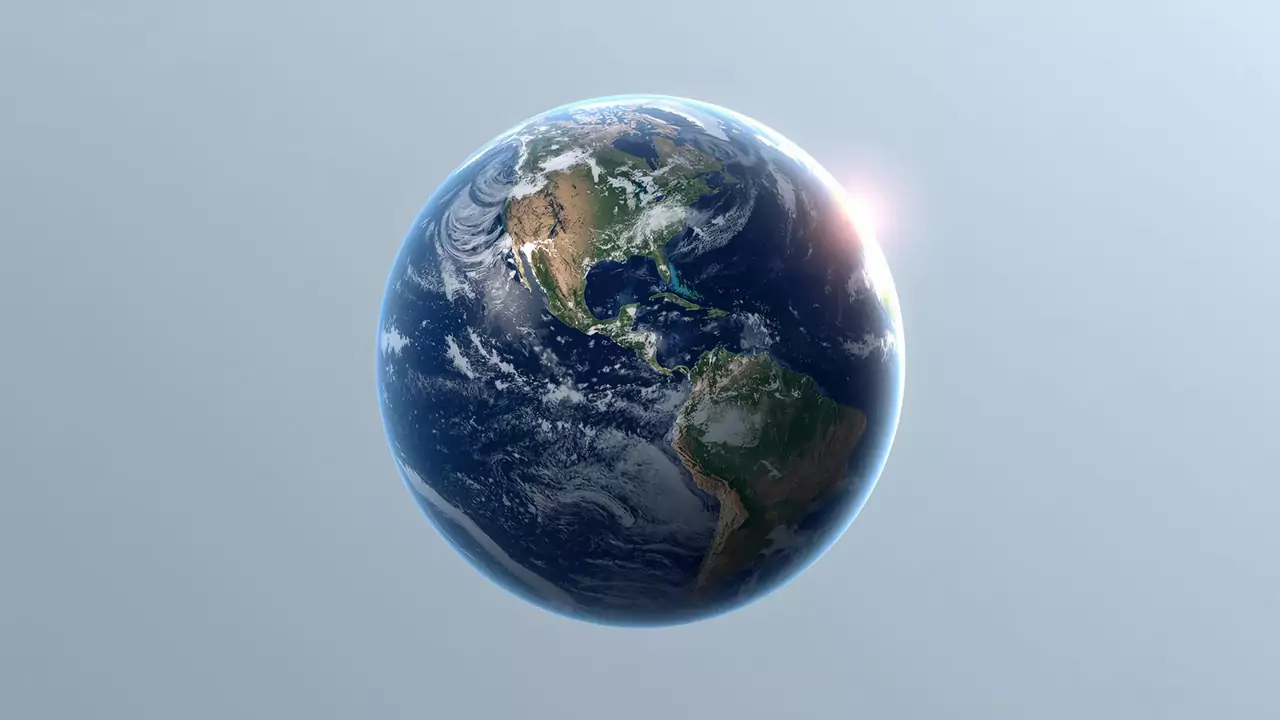
The Earth’s circumference along the equator measures approximately 40,075 kilometers (24,901 miles), and its polar circumference at about 40,008 km (24,860 miles), which of course is quite a long way. In case you are planning a trip around the world, the quickest route is the Great Circle route. It is simply a fancy way of saying a curved line that runs along the shape of the earth. You do not need to fly across the North or South pole to get the shortest route.
That said, walking routes need to follow land masses, which means you can’t walk in a perfectly straight line along the equator, as you would need to contend with steep inclines, oceans, and huge bodies of water along the way. This means that actual walking distances could be much longer. Many adventurers also choose to enjoy more scenic or safer routes, which can include detours through mountains, forests, and cities.
This is something people always dreamt of, and the best-known example shows up in the book Around the World in Eighty Days, authored in 1872. It tells the story of a man named Phileas Fogg who departed London and visited pretty much all the locations around the world including India, China, Japan and America, before traveling back home (London).
Of course for those looking to simply travel around the world in any way, flying is much faster. It would take a few days on average depending on stop overs to complete this journey by air, but when it comes to comparing ‘how long to fly around the world’ versus ‘how long to walk around the world’, the difference is huge. Walking across the planet could take many months or years to complete, but it’s much faster by plane.
How Long Would It Take to Walk Around the Earth?
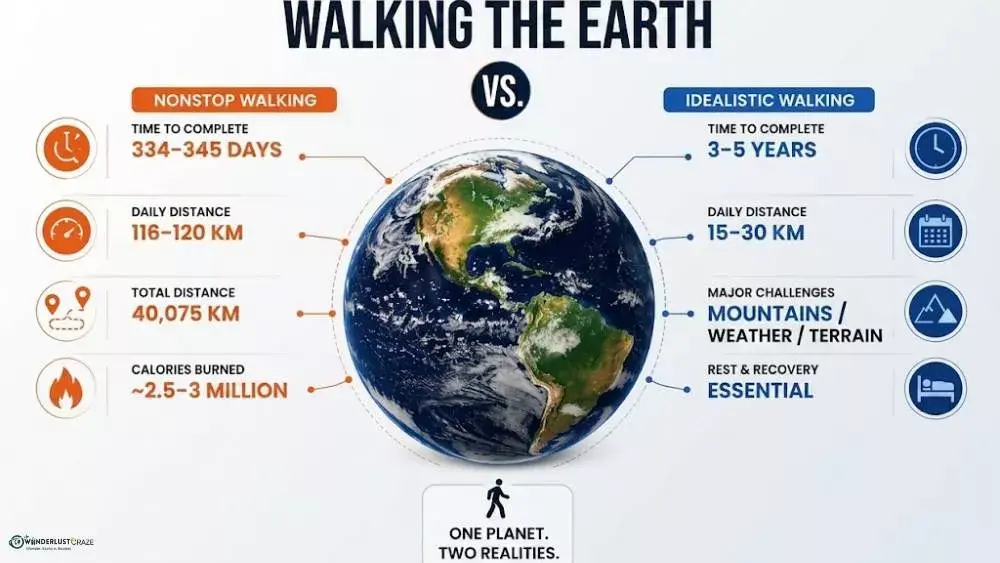
Following is a comparison of how long it would take to walk around the Earth if a man walks nonstop, 8 hrs/day, and a realistic approach:
| Scenario | Assumption | Approximate Result | What It Means |
|---|---|---|---|
| Nonstop theoretical walk | 3 mph, 24 hours/day | ~346 days | Pure mathematical thought experiment |
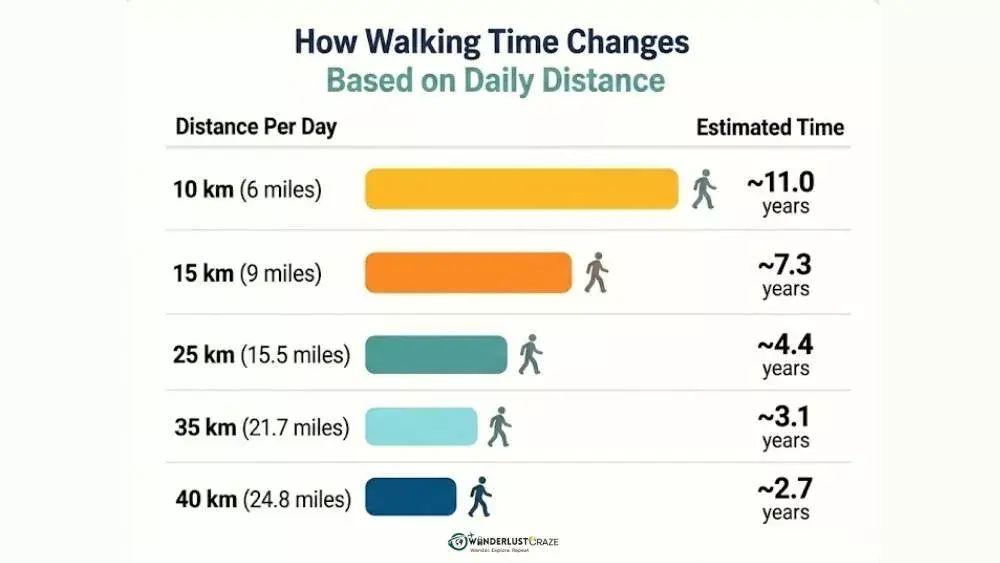
| Walking 8 hours/day | 3 mph × 8 hours = ~24 miles/day | ~2.84 years | Mathematical schedule with no rest days |
| Walking 12 miles/day | 12 miles every day | ~5.7 years | Slower daily walking schedule |
| Real-world global expedition | Walking days + rest + borders + route detours + oceans + weather + logistical pauses | No single fixed duration | Depends heavily on expedition rules and route |
Can You Literally Walk Around the Earth?
Yes, it is possible to complete a journey around the world on foot, but not by literally following Earth’s equator from start to finish. The equatorial circumference is about 40,075 km (24,901 miles), but much of that imaginary line crosses oceans, so there is no continuous walking route around the planet. NOAA describes Earth’s equatorial circumference as roughly 40,076.5 km, with a slightly shorter route around the poles because Earth is not a perfect sphere.
This is where the simple calculation and a real expedition begin to separate. Walking 24,901 miles at a fixed pace tells us how much walking time would theoretically be required to cover the circumference. An actual circumnavigation has to work around continents, oceans, international borders, terrain and available routes, so the path followed on foot will never look like a neat line around the equator.
In other words, you can walk around the world, but you cannot walk every mile of a continuous 40,075-km equatorial loop because there is simply too much ocean in the way.
What Counts as Walking Around the World?
There is no single road painted around the planet showing where a world walk begins and ends, so organizations that document global circumnavigations use specific rules to decide what qualifies.
Under the current rules of the World Runners Association (WRA), a recognized circumnavigation on foot must cover at least 26,232 km (16,301 miles) on foot. The route must also cross all lines of longitude and generally continue around the world in the same direction.
For the standard route, participants must cross at least four continents from coast to coast, walking at least 3,000 km on each qualifying continent. The continents also need to be crossed in a geographically logical order rather than jumping backwards and forwards around the globe.
The WRA also requires a qualifying route to pass near a pair of antipodal points places lying roughly opposite one another on Earth — although a special Northern Hemisphere route is treated differently under its rules.
Of course, walkers still need a way to cross the oceans. The WRA allows the sections between continents to be completed by plane, ship or another form of transport, but those miles cannot be added to the distance claimed as walking. The purpose is to keep the overall journey moving around Earth while counting only the distance actually covered on foot.
For world walkers, the WRA says the same circumnavigation rules generally apply as they do to world runners, except for its rule requiring runners to complete more than half of the distance by running.
So, a recognized walk around the world does not mean someone has physically walked all 40,075 km of Earth’s equator. It means they have completed a qualifying global route on foot while meeting defined distance, direction and continental-crossing requirements.
Theoretical Circumference vs Real-World Circumnavigation
| Theoretical Walk Around Earth | Real-World Circumnavigation | |
|---|---|---|
| Distance basis | Earth’s ~40,075 km equatorial circumference | Route actually covered on foot |
| Can the whole route be walked? | No, because the equator crosses oceans | Yes, by walking across land and using transport between continents |
| Main purpose | Calculate theoretical walking time | Complete a journey around the planet |
| WRA minimum on foot | Not applicable | 26,232 km |
| Ocean crossings | Not considered in the basic calculation | May use ship, plane or other transport, but that distance does not count as walking |
| Time estimate | Can be mathematically calculated | Depends heavily on route, pace, rest and logistics |
Why Real Circumnavigations Take So Long
Even the most athletic adventurers can’t walk non stop so it’s important to consider the following practicalities that could hinder your journey:
- Sleep and rest: When embarking on such a challenging adventure, especially by foot, sleep and rest are crucial for good recovery. No person could maintain the theoretical nonstop pace for hundreds of days. Sleep, recovery, food, injuries and changing terrain make the nonstop figure a mathematical thought experiment rather than a travel estimate.
- Meals and Nutrition: Walking such long distances takes up a lot of energy, especially when you’re not taking much time to rest. For this reason, staying fueled with high calorie, high nutritious meals is essential. You can’t spend this intense journey surviving off granola bars and grab-and-go snacks.
- Weather and Terrain: Deserts, mountains, oceans, and weather conditions often make walking incredibly challenging or impossible. For this reason, boats or other modes of transportation are sometimes necessary to be able to complete the journey.
- Borders and Politics: Traversing through various countries involves Dealing with various visas, permits, areas of conflict, and restricted areas. This can delay progress and mean you need to plan another route.
- Physical Fitness: Your ability to ensure long distances, recover from any injuries sustained or illnesses, and even your ability to mentally endure the feat of walking non-stop can all be factors that affect your speed and consistency in crossing such long distances.
Has Anyone Actually Walked Around the World?
Yes, people have completed journeys recognized as walking or traveling around the world on foot, although the route is very different from simply following Earth’s equator.
One of the earliest reported attempts was by American traveler George Matthew Schilling, who is said to have walked around the world between 1897 and 1904. However, the first verified circumnavigation by walking recognized by Guinness World Records belongs to David Kunst. He began his journey on June 20, 1970, and finished on October 5, 1974, after walking about 23,250 km (14,450 miles) across four continents.
That is an important distinction because walking around the world does not mean physically covering Earth’s entire 40,075-km equatorial circumference on foot. Oceans make that impossible. Modern circumnavigations therefore combine long overland sections on foot with transportation between continents. The World Runners Association (WRA), which oversees documented attempts to circumnavigate Earth on foot, currently requires a qualifying route to cover at least 26,232 km on foot, cross all lines of longitude and meet additional route requirements. Distances traveled by plane, ship or other transport between land sections do not count toward the walking total.
There are also several well-documented modern examples. The WRA lists Jesper Kenn Olsen, Rosie Swale-Pope, Tom Denniss, Tony Mangan, Kevin Carr, Serge Girard, and Marie Leautey among athletes whose circumnavigations on foot have been formally recognized under its rules. Their journeys show just how widely the times can vary: Serge Girard completed a 26,232-km world run in 434 days, while Rosie Swale-Pope’s 32,187-km journey took 1,789 days, or almost five years. These were endurance runs rather than ordinary walking trips, so they should not be treated as typical walking speeds, but they are useful real-world examples of how circumnavigation works.
Then there is Karl Bushby’s Goliath Expedition, which shows the opposite extreme. Bushby left southern South America in 1998 with two unusually strict rules: he would not use transportation to advance his journey, and he would not return home until the expedition was finished. Nearly three decades later, the expedition is now described by his official team as being in its final months. His experience shows why a real expedition can take far longer than the simple “distance divided by walking speed” calculation: borders, weather, politics, ocean crossings and years of logistical delays can matter just as much as walking pace.
Practical Takeaways to Consider Walking Across the World
If you dream of embarking on the adventure of a lifetime, it’s a good idea to prepare with a smaller-scale expedition before making any attempts to walk across the entire world. Some things to consider when preparing for your next adventure include:
- Embarking on long tracks on iconic trails or some of the best hikes in the world.
- Planning extended walking tours across cities or countries is one of the best travel tips for beginners, as there are plenty of people, signs, and civilization around in case you get lost.
- Packing up some solo travel essentials and heading off on the journey alone in order to connect more deeply with your surroundings.
Walking around the earth isn’t just about covering a huge number of miles. Instead, it’s about embracing the adventure, discovering new cultures, and challenging your own mental and physical limits. Whether you’re curious about how many miles it is to go around the world, or whether you’re simply dreaming of wandering the world at a more leisurely pace, it’s an incredible reminder of the planet’s huge scale and deep beauty.
Read Also: Travel Quotes to Ignite the Inner Wanderlust
Frequently Asked Questions:
The Earth’s circumference at the equator is approximately 24,901 miles or roughly 40,075 kilometers. Now here is the twist, if we measure the circumference from the poles instead, the distance would be 24, 860 miles which is not a massive difference but phew ….. every mile counts while walking.
How Long Would it Take to Drive Around the Earth?
If you drive a car at a constant speed of 60 mph without stopping, you can cover the distance in 17 days which is not bad on paper! But realistically, it would take few a month or more as no one can drive non-stop.
At its usual speed of approximately 575 to 600 mph (925 to 965 km/h), a passenger aircraft
could travel around the earth in a matter of about 42 hours . That would take place in an
ideal world, however, in the real life it will take a lot more time. There is no plane in the
world that can travel around the globe without stopping.
Considering earth’s equatorial circumference of about 40,075 km and an average step length of around 2.5 feet, it would take roughly 52.6 million steps to walk around the world (or the equator). The best a man could do in 24 hours was 228.930 km (142.25 miles) in 1976.