The 7 Natural Wonders of the World
What Are the 7 Natural Wonders of the World?
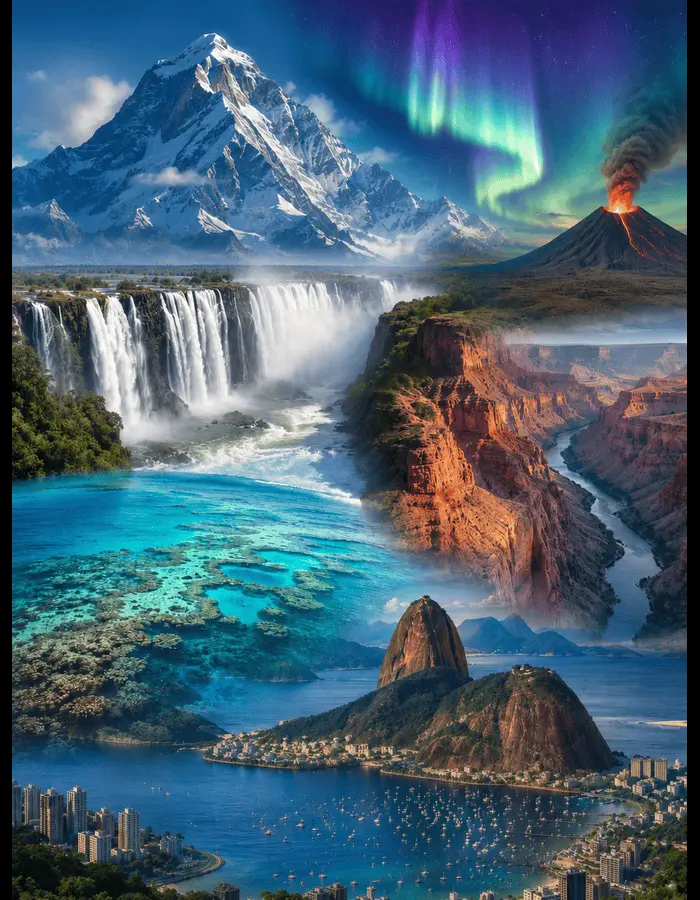
The 7 Natural Wonders of the World are the Grand Canyon, Great Barrier Reef, Victoria Falls, Mount Everest, Aurora Borealis, Parícutin Volcano, and the Harbor of Rio de Janeiro. They are the natural counterpart to the man-made Seven Wonders: no architects, no empires, no carved stone, just rivers, reefs, mountains, lava, light, and time doing their work. This is the original natural-wonders list most commonly referenced today, not the later New7Wonders of Nature public-vote list.
Long before anyone carved a temple facade or stacked a single pyramid block, the planet was already building its own monuments. Some took a few weeks. Some took a few million years. The 7 Natural Wonders of the World are the result: a canyon a mile deep, a curtain of falling water you can hear from miles away, a reef system so large it reshapes the map of an entire coastline, and a volcano that erupted out of a farmer’s cornfield in living memory.
Why Are There Different Natural Wonders Lists?
Unlike the New Seven Wonders of the World, the man-made list of monuments chosen by global public vote in 2007, the natural wonders of the world were never built, only revealed.
The list most people refer to today traces back to a 1997 CNN selection that surveyed global and continental natural phenomena, later adopted and championed by the nonprofit Seven Natural Wonders, which formed in 2008 specifically to protect and promote these sites.
It’s worth knowing this, because a different organization, the same Swiss foundation behind the man-made New7Wonders vote, ran its own public poll between 2007 and 2011 and crowned an entirely different lineup (the Amazon, Halong Bay, and Komodo Island among them).
That list exists too, but it belongs to a different vote and a different moment. The seven below are the classic natural seven: the Grand Canyon, the Great Barrier Reef, Victoria Falls, Mount Everest, the Aurora Borealis, Parícutin Volcano, and the Harbor of Rio de Janeiro.
| List | Chosen By | Year | Includes |
|---|---|---|---|
| Original 7 Natural Wonders | CNN / Seven Natural Wonders | 1997 | Grand Canyon, Great Barrier Reef, Victoria Falls, Mount Everest, Aurora Borealis, Parícutin, Rio Harbor |
| New7Wonders of Nature | Public global vote | 2011 | Amazon, Ha Long Bay, Table Mountain, Komodo, Jeju Island, Puerto Princesa Underground River, Iguazu Falls |
We’ve already covered the Seven Wonders of the World, the man-made marvels built by human hands across thousands of years. This is the other half of the story, the half nature wrote without asking anyone’s permission.
The 7 Natural Wonders of the World at a Glance
| Natural Wonder | Location | Key Fact |
|---|---|---|
| Grand Canyon | Arizona, USA | 277 miles long, over a mile deep, carved by the Colorado River |
| Great Barrier Reef | Queensland, Australia | World’s largest coral reef system, stretching 2,300 km |
| Victoria Falls | Zambia / Zimbabwe | World’s largest sheet of falling water: 108m tall, 1,708m wide |
| Mount Everest | Nepal / Tibet | Highest peak on Earth at 29,031.7 feet (8,848.86m) |
| Aurora Borealis | Arctic regions | Solar particles colliding with Earth’s magnetic field |
| Parícutin Volcano | Michoacán, Mexico | Born in a cornfield in 1943, with its eruption documented from start to finish |
| Harbor of Rio de Janeiro | Rio de Janeiro, Brazil | One of the world’s most dramatic natural harbors, framed by Sugarloaf Mountain |
1. The Grand Canyon, Arizona
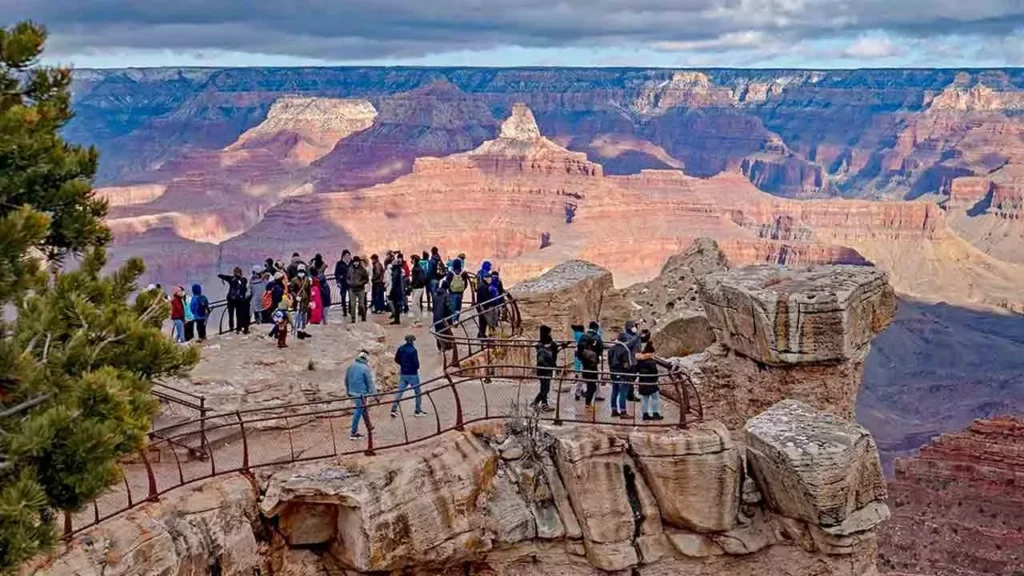
There’s a reason photographs never quite prepare you for the Grand Canyon. No frame is wide enough. The canyon runs 277 miles along the Colorado River, drops roughly a mile from rim to river in many places, and reaches about 6,000 feet at its deepest. Its walls expose nearly two billion years of Earth’s story, from ancient basement rocks deep inside the Inner Gorge to younger layers such as the Kaibab Limestone along the rim.
The canyon itself is younger than the rock it cuts through. Most geologists still place the Colorado River’s major carving work within roughly the last five to six million years. But the canyon’s backstory is messier than one neat age. Geological research has suggested that some older western paleocanyons may have been cut tens of millions of years earlier, possibly as far back as 70 million years ago, before the modern river system finally tied the canyon together.
The Havasupai, Navajo, Hopi, Hualapai, and several other tribes have called this land home for centuries, and their histories run as deep as the rock layers. In 1869, John Wesley Powell led a small crew down the Green and Colorado Rivers in wooden boats, turning a three-month ordeal through canyon country into one of the defining scientific journeys of the American West.
A practical note worth flagging: the canyon floor is dramatically hotter than the rims above it, and that difference can turn dangerous fast. In June 2026, three hikers died from suspected heat-related illness in the Inner Canyon during a heat stretch where midday shade temperatures can exceed 109°F (43°C). If you’re hiking below the rim between May and September, start before dawn, carry far more water than feels necessary, and treat the heat with real respect.
2. The Great Barrier Reef, Australia
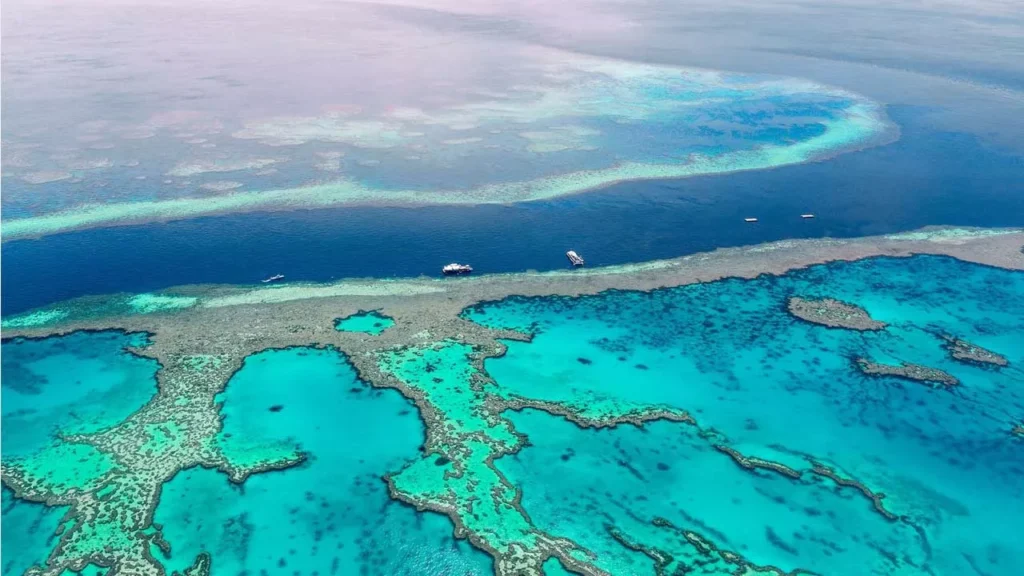
Off the northeastern coast of Queensland lies the world’s largest coral reef system: the Great Barrier Reef. It stretches more than 2,300 kilometers, covers 344,400 square kilometers, and is made up of around 3,000 individual reefs, along with islands, coral cays, seagrass beds, and deep blue channels built slowly by living coral over immense stretches of time.
The numbers inside the reef are almost as staggering as its overall size. More than 1,500 species of fish and 400 species of coral call it home, alongside six of the world’s seven sea turtle species and at least 30 species of whale and dolphin. Some massive coral colonies have been growing for centuries, quietly holding time in their skeletons long before Captain Cook’s Endeavour ran aground on the reef in 1770.
The honest part of this story is that the reef is under real strain. Rising ocean temperatures have triggered repeated mass bleaching events, including another in 2025. It was the sixth mass bleaching event since 2016 and the second time the reef had suffered back-to-back bleaching years. Bleaching does not always kill coral outright, but it leaves it hungry, pale, and vulnerable. Recovery depends on the water cooling before the damage has time to deepen.
3. Victoria Falls, Zambia and Zimbabwe
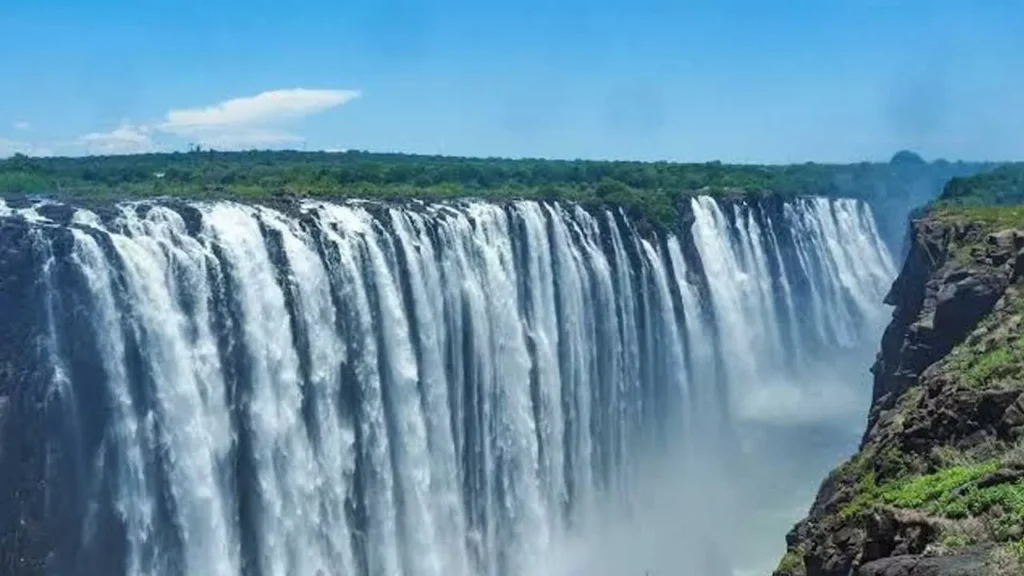
Locally, it’s called Mosi-oa-Tunya, “the smoke that thunders,” and the name undersells it slightly. Victoria Falls is not the tallest waterfall in the world, nor the widest taken on its own. What makes it extraordinary is the combination: a 1,708-meter-wide curtain of water dropping into the Zambezi Gorge, with sections of the fall plunging up to around 108 meters.
Scottish missionary and explorer David Livingstone became the first European recorded to have seen the falls in 1855. He later wrote that the view had “never been seen before by European eyes,” and that scenes so lovely must have been gazed upon by angels in flight. He named the falls after Queen Victoria, though the older local name, Mosi-oa-Tunya, “the smoke that thunders,” has never really left the place.
What you actually see at Victoria Falls depends almost entirely on when you go, which makes timing the single most important piece of planning advice here.
- Visit during the flood season, February through May, and you’ll witness the falls at their most thunderous: spray rising over 400 meters into the sky, rainbows arcing constantly, and a wall of white noise that drowns out conversation.
- Visit during the dry season, roughly August through January, and the flow drops enough to reveal the underlying rock face and, for the genuinely fearless, open access to Devil’s Pool, a natural rock pool on the lip of the falls where guided swimmers can lie at the very edge of a 108-meter drop.
- October and November typically offer the calmest water for it. Just don’t expect both experiences on the same trip; full flood and Devil’s Pool access essentially never overlap.
4. Mount Everest, Nepal and Tibet
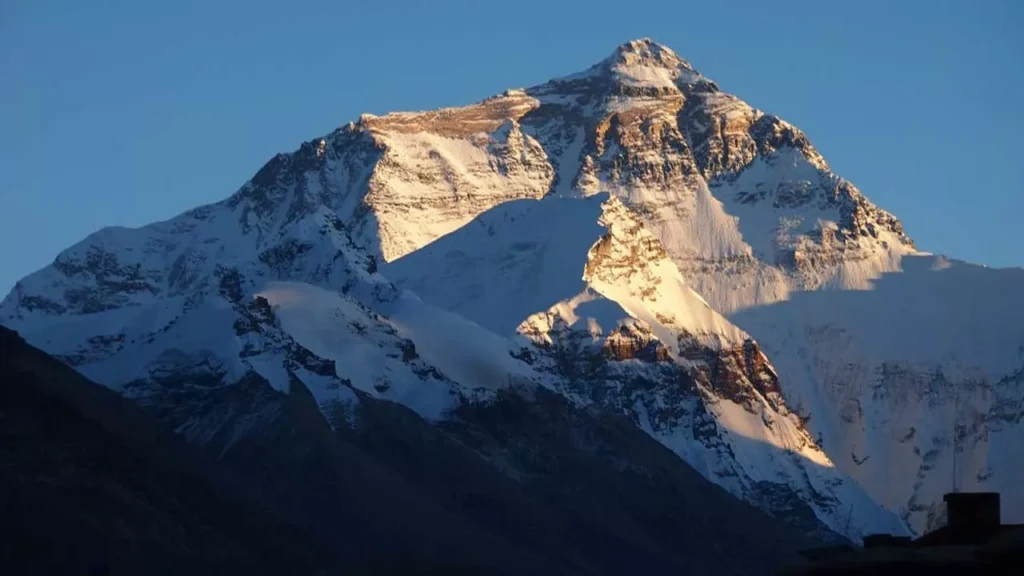
At 29,031.7 feet (8,848.86 meters), officially remeasured jointly by Nepal and China in 2020, Mount Everest is the highest point on Earth above sea level. Nepal calls it Sagarmatha; in Tibet, it’s Chomolungma, “Goddess Mother of the World.” Both names carry more reverence than the English one does.
Sir Edmund Hillary and Tenzing Norgay made the first confirmed ascent on May 29, 1953, a feat that remains one of the defining moments in exploration history. More than 70 years later, the mountain still grows, roughly four millimeters a year, as the Indian tectonic plate continues pushing into the Eurasian plate beneath it.
Climbing it today is a very different proposition from Hillary and Norgay’s era, and a far more expensive one. Nepal’s revised Everest royalty fee took effect from September 2025, raising the normal-route spring permit for foreign climbers from $11,000 to $15,000. That permit is only one line on the bill. Once guides, oxygen, gear, logistics, insurance, travel, and support crews enter the picture, a 2026 Everest expedition can easily move from the mid-five figures into six-figure territory.
5. The Aurora Borealis
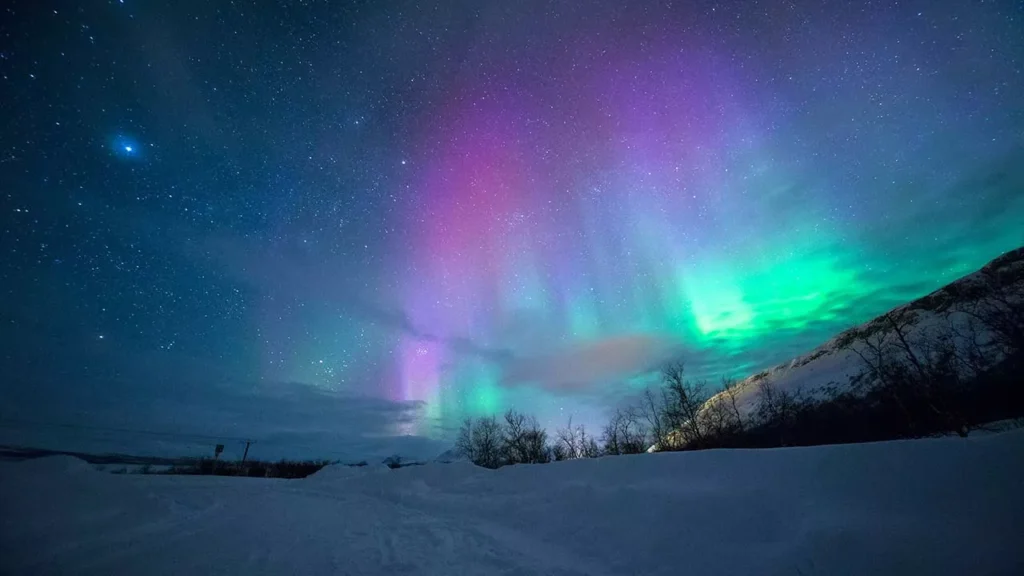
Most natural wonders are places. This one is a phenomenon, which makes it the strangest entry on the list and arguably the most magical. The Aurora Borealis, the northern lights, happens when charged particles from the sun collide with Earth’s magnetic field and slam into gases in the upper atmosphere, roughly 60 to 200 miles up. Oxygen produces the familiar green and occasional red glow; nitrogen produces the rarer blues and purples. The display was named by Galileo in 1619, combining Aurora, the Roman goddess of dawn, with Boreas, the Greek god of the north wind.
Here is the part worth knowing if a trip is on your radar: NASA and NOAA announced in 2024 that the Sun had entered the maximum phase of Solar Cycle 25, the stretch of the solar cycle when flares, sunspots, and geomagnetic storms become more active. By 2026, the cycle may no longer be sitting at its absolute peak, but it is still close enough to that high-activity period to make the northern lights feel more generous than they were a decade ago.
Norway’s Tromsø, Iceland, Swedish and Finnish Lapland, and Alaska all sit reliably beneath the auroral oval and remain the safest bets for sightings. The viewing season runs from late September through late March, when nights are long and dark enough for the lights to show. Aim for clear skies, minimal light pollution, a window between 10pm and 2am local time, and ideally a new moon, since a bright moon can wash out fainter displays. Patience matters more than any of it; the aurora answers to the sun’s schedule, not yours.
6. Parícutin Volcano, Mexico
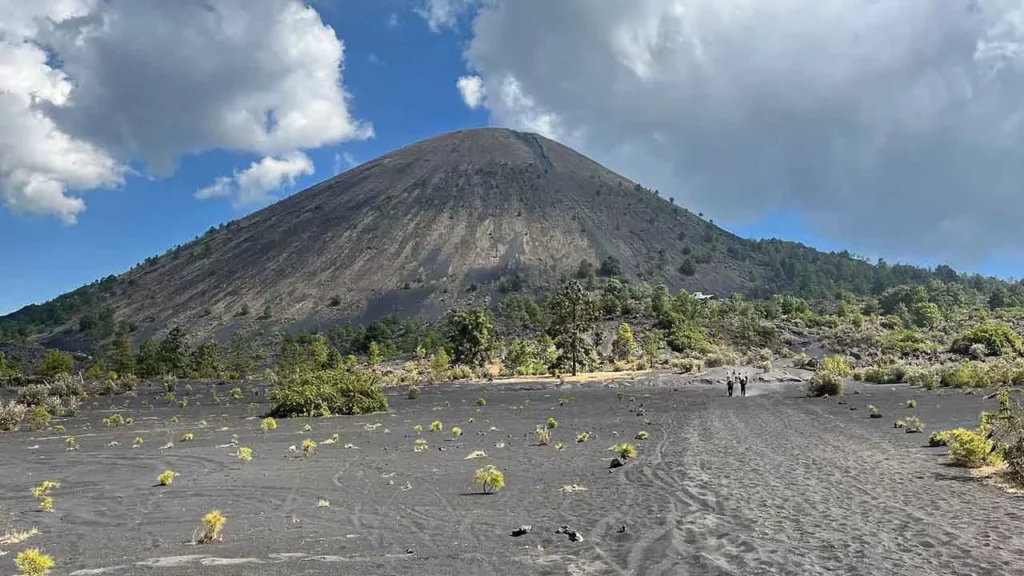
Most volcanoes have been around since before recorded history. Parícutin has not. On February 20, 1943, a farmer named Dionisio Pulido was clearing his cornfield near the village of Parícutin in Michoacán when the ground swelled, cracked open, and began hissing smoke. By the next morning, a cinder cone had risen 50 meters. Within a week it was 150 meters tall. Within a year, 365 meters.
It kept erupting for nine years, finally going quiet in 1952 after building a cone roughly 424 meters high. What makes Parícutin so rare is not just that it appeared in living memory, but that scientists were able to watch and document the full life of the eruption, from a cracked cornfield to a finished cinder cone.
The eruption swallowed two villages whole. Lava entered the town of San Juan Parangaricutiro in 1944 and slowly buried it, leaving only the steeple and facade of its unfinished church rising out of the solidified rock, an image that has become the volcano’s defining postcard. No one died directly from the lava itself; residents had time to evacuate as the flows crept forward at a walkable pace. Three people were killed by lightning generated within the ash plumes, an oddly specific footnote to an otherwise non-lethal disaster.
Today the volcano and its half-buried church sit near the Purépecha village of Angahuan, reachable by a hike or horseback ride across the now-solid lava field. The cone is monogenetic, meaning it formed from a single eruptive episode and is not expected to erupt again. That does not make the surrounding volcanic region sleepy, but it does make Parícutin itself one of the rare volcanoes whose story feels unusually complete.
7. The Harbor of Rio de Janeiro
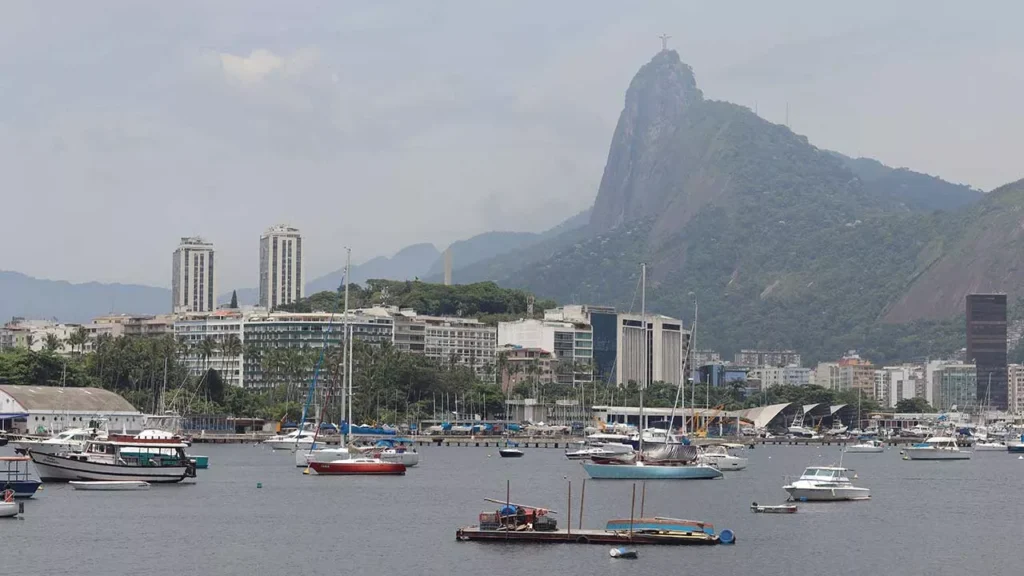
Most natural wonders are remote. This one has a samba beat. The Harbor of Rio de Janeiro is better known as Guanabara Bay, and its fame comes less from one clean statistic than from the way the whole scene gathers itself: Atlantic water, city shoreline, island-dotted blue, and granite peaks rising around one of the most photographed harbors on Earth.
Portuguese explorers arrived around 1502 and mistook the bay for the mouth of a great river, giving rise to the name Rio de Janeiro, “River of January.” The mistake lasted longer than the correction.
Today, Guanabara Bay is still one of the world’s most recognizable natural harbors: Atlantic water held between granite peaks, Sugarloaf Mountain guarding the entrance, and Corcovado rising behind the city with Christ the Redeemer looking out over the view. That makes Rio one of the rare places where a classic natural wonder and one of the man-made New Seven Wonders appear to share the same skyline.
The view from above can feel almost unreal. At water level, though, the story is more complicated. Decades of urban runoff and pollution have left parts of the bay struggling, which is why a boat ride is better treated as a scenic experience than a swimming invitation.
Sugarloaf’s cable car and Corcovado’s mountaintop platform are the two essential viewpoints, and they are best treated as separate moments rather than squeezed into the same hurried stop. Corcovado catches the morning light beautifully, especially when the city is still shaking off the haze. Sugarloaf belongs to sunset, when the bay darkens, the mountains turn into silhouettes, and Rio starts to glow around the water.
Why These Seven Still Matter
The man-made Seven Wonders took human ingenuity, centuries of labor, and in some cases entire empires to build. The natural ones took something stranger: deep time, raw geology, and in Parícutin’s case, nine years and one very unlucky cornfield. Seen together, they make an odd kind of sense. One canyon shows you what two billion years of erosion looks like. One waterfall shows you what an entire river falling at once sounds like. One light show reminds you the sky is still capable of genuine sorcery.
Best Time to Visit Each Natural Wonder
| Wonder | Best Time to Visit | Why |
|---|---|---|
| Grand Canyon | March-May, September-November | Better temperatures |
| Great Barrier Reef | June-October | Clearer water, drier weather |
| Victoria Falls | February-May for full flow, August-January for lower water views | Different experiences |
| Mount Everest Base Camp | March-May, September-November | Trekking seasons |
| Aurora Borealis | September-March | Long dark nights |
| Parícutin Volcano | November-April | Drier hiking conditions |
| Rio Harbor | May-October | Clearer, drier weather |
Frequently Asked Questions
What are the 7 natural wonders of the world?
The Grand Canyon, the Great Barrier Reef, Victoria Falls, Mount Everest, the Aurora Borealis, Parícutin Volcano, and the Harbor of Rio de Janeiro (Guanabara Bay). The list traces to a 1997 CNN report and has since been maintained by the nonprofit Seven Natural Wonders.
Who decided the list of the seven natural wonders?
CNN compiled the original list in 1997. A separate organization, Seven Natural Wonders, formed in 2008 to protect and promote it. A different group, the Swiss-based New7Wonders Foundation, later ran its own public vote between 2007 and 2011 and produced an entirely different list (including the Amazon, Halong Bay, and Komodo Island), but that list is distinct from the original seven covered here.
Is the Grand Canyon the deepest canyon in the world?
No. At its deepest, the Grand Canyon reaches a little over a mile (around 1.8 km). Tibet’s Yarlung Tsangpo Grand Canyon is significantly deeper, plunging more than 5,300 meters (17,490 feet) in places, making it the deepest canyon on Earth. The Grand Canyon’s fame rests on its length, width, and the exposed geological history in its walls, not its depth alone.
Is Niagara Falls one of the seven natural wonders?
No. That distinction belongs to Victoria Falls, which is nearly twice Niagara’s height and one and a half times its width, and holds the title of the world’s largest sheet of falling water. Niagara Falls is widely loved and heavily visited, but it has never appeared on the official seven natural wonders list.
Why is the Aurora Borealis on a list with physical landmarks?
Because it meets the same bar the others do: it’s entirely natural, genuinely awe-inducing, and impossible to manufacture. It’s the only entry on the list that isn’t a fixed location, but its inclusion dates back to CNN’s original 1997 list and has remained ever since.