
National Dish of America: Does the USA Have an Official National Dish?
The United States does not have an official national dish recognized by federal law. In everyday conversation, though, the hamburger is the strongest unofficial answer because it shows up everywhere from diners and drive-ins to backyard cookouts and fast-food chains.
The U.S. does not have one official dish the way some countries have formally recognized national foods. That is partly because American cuisine is built from many regions, migrant traditions, Native foodways, and local habits that do not collapse into one plate. The hamburger still rises to the top because it feels at home in so many familiar American settings, from backyard cookouts and roadside diners to national fast-food chains. The recent CBS News poll gives that cultural association some public backing.
Does America Have an Official National Dish?
The simple answer is NO, and it relates to the country’s size and diversity rather than to any shortage of famous foods. America is a big country with mixed identities and a single recipe does not feel fully representative of this country.
Key takeaway: America has no officially recognized national dish, but hamburgers are widely considered the unofficial national dish.
Some countries have one dish that people broadly accept as a national symbol, even when their regional cuisines are very different. The United States has never settled as clearly on one answer. Its food culture developed through Indigenous traditions, immigration, settlement, trade, enslavement and regional adaptation.
Why the Hamburger Is Considered America’s Unofficial National Dish
The hamburger fits the way Americans actually eat. History.com traces the burger’s popularity through early 20th-century White Castle. Opened in Kansas in 1921, it helped boost the hamburger’s reputation by making it feel modern and mass-market friendly.
White Castle calls itself America’s first fast-food hamburger chain. It was originated in 1921. McDonald’s reported 45,356 restaurants worldwide at year-end 2025, which is one reason the burger remains so closely linked to American food culture. Travelers think of U.S. food as a whole exported system of burgers, fries, drive-through, and standardized comfort food
The burger also has the best cultural reach. The burger culture spread in the world alongside American fast food after World War II. Besides, McDonald’s popularity shows how deeply that image has traveled. For Americans, a burger is not just a meal but also a shorthand for the country’s casual dining style and its road-trip culture.
Consumption data supports beef-based food. According to USDA ERS, chicken has been the most available meat in the U.S. since 2010, but beef is still massive, with per capita beef availability projected at 56.9 pounds per person for 2026. While this does not equate to high consumption of burgers, it does explain why a beef sandwich can still carry so much symbolic weight
CBS News’ June 2026 poll has put hamburgers on top, ahead of barbecue, apple pie, and hot dogs. It is surprising that even without a federal accreditation the burger has won the unofficial title in the public mind.
Other Foods That Could Be Considered America’s National Dish
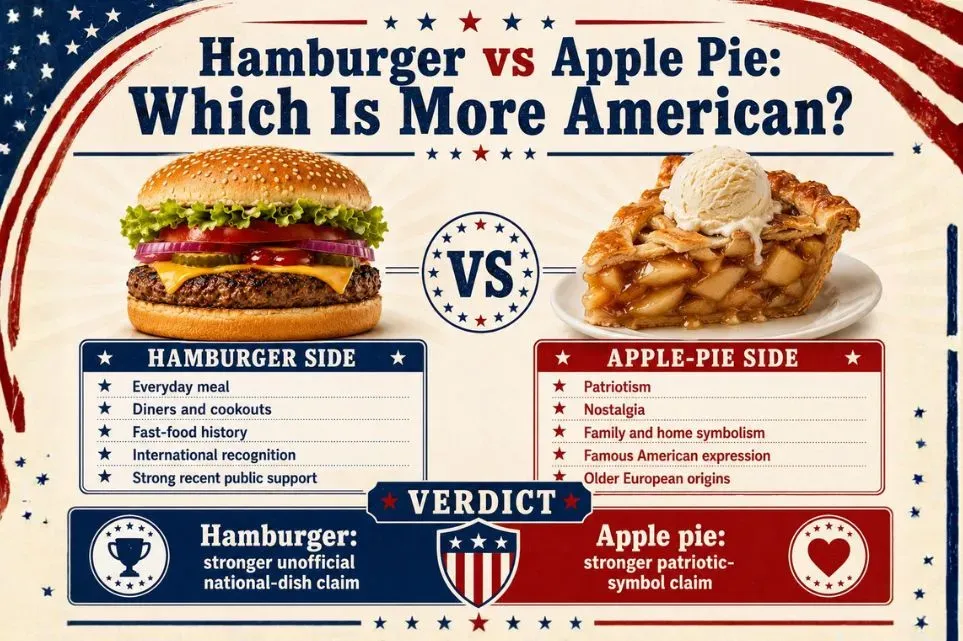
Apple pie is the sentimental rival. History.com links apple pie to American identity in the 20th century, particularly through wartime patriotism and the phrase “as American as apple pie.” The problem is that the dish itself has older European roots, so it feels American as a symbol more than as an origin story. It is familiar and deeply nostalgic, but it does not describe how Americans eat every day.
Hot dogs also deserve consideration. This typical American summer grill food has its origins stretching back much further than the U.S, according to History.com. The hot dog is tied to ballparks, street food, and July Fourth cookouts, giving it a strong patriotic energy. You are just as likely to find a hot dog cart keeping crowds happy near the trailheads of rugged East Coast national parks as you are to find one parked on a bustling city sidewalk. Even so, it feels narrower than the burger since it is more seasonal and less universally chosen across generations.
Barbecue is arguably the most regionally beloved contender. National Geographic describes the American South as a place where barbecue is ubiquitous but strongly regional, with different cuts, sauces, and traditions from state to state. That makes barbecue one of the best expressions of American food culture, yet it also proves why it is hard to make the case for barbecue as the single national dish. The country does not agree on one barbecue style, and that disagreement is the point across all fifty U.S. states.
Fried chicken has a greater claim than many people realize. Smithsonian and National Geographic both connect its Southern history to African and Scottish influences. Colonel Sanders turned fried chicken into a national fast-food success story. It is one of the most important American comfort foods, but we still consider it a regional tradition before a national symbol.
Mac and cheese is the fifth on this list of National Dish of America. Thomas Jefferson helped spread its popularity in elite American dining, while his enslaved chef James Hemings played the more important role in adapting the recipe. Later, boxed mac and cheese turned it into a Depression-era and postwar essential. It is as American as comfort food gets, yet it functions more as a side dish or family meal than a defining national plate.
Thanksgiving turkey has a ritual power. There is no solid evidence turkey was the centerpiece of the 1621 meal. According to Smithsonian, wild turkey may have been served, but goose or duck may have been more likely, and History.com says there is no solid evidence turkey was on the menu in late 1621. Modern Thanksgiving meals across the country usually include a turkey. But, Thanksgiving is a holiday tradition, not an everyday national dish.
How Regional Cuisine Shapes American Food Culture
The national dish debate gets interesting here. America does not just follow one food culture but a group of food cultures, and the regions are as much important as the country itself. Whether you are stopping for pit-style meats near wonderful mountains or enjoying a classic fish fry close to the cleanest lakes, local ingredients dictate the menu. For instance, American South is a place where history, culture, and identity connect through food, with barbecue everywhere and local flavors shifting from one state to the next.
New England’s lobster rolls have moved from fisherman’s lunch to an important part of the region’s food culture. This coastal staple draws thousands of visitors every summer, transforming sleepy seaside villages into top honeymoon destinations for couples who prefer ocean breezes and fresh catch over traditional resort getaways. This seafood is about how the coast, local labor, and travel identity become part of a region’s table.
Louisiana goes in another direction entirely. Cajun and Creole food are shaped by French, Spanish, African, Sicilian, Caribbean, Irish, German, and Native American influences. Such a mix is common across the U.S.; therefore, a single official dish feels too small for the country.
California fusion cuisine shows the modern version of the same idea. California cuisine drew from Asian ingredients and local produce. Chefs such as Alice Waters and Wolfgang Puck helped redefine American dining. The Midwest adds its own comfort-food identity, from chili and cinnamon rolls in regional pockets to other local dishes that carry hometown loyalty.
Different ethnicities in America have created a cuisine that is varied and diverse, and many foods now seen as American began as traditional dishes from somewhere else.
What Food Represents America Best Today?
If I strip away nostalgia and look at what actually represents the U.S. best today, I land on the hamburger. Apple pie has the sentimental pull, and Barbecue enjoys the regional credibility. Hot dogs possess holiday visibility. Still, the hamburger holds the widest everyday reach, the perfect global association with American fast food, and the greatest recent public support.
The following table compares the main contenders in the soundest way.
| Food | Why It’s Considered National | Strength of Claim |
|---|---|---|
| Hamburger | Fast-food icon, cookout staple, global symbol of U.S. eating | Clearest unofficial choice |
| Apple Pie | Patriotism, nostalgia, “as American as apple pie” | Very convincing symbolic claim |
| Barbecue | Regional pride, cookout culture, Southern influence | Compelling, but too regional and varied |
| Hot Dog | Ballparks, summer grilling, July Fourth tradition | Solid cultural icon, narrower than burgers |
Regional Cuisine Snapshot
| Region | Food Identity | What It Shows |
|---|---|---|
| Southern cuisine | Barbecue, fried chicken, soul food | Regional depth and legacy |
| New England | Lobster rolls, seafood, coastal cooking | Maritime identity and place-based eating |
| Louisiana | Cajun and Creole dishes | Immigrant and African influence in one regional kitchen |
| California | Fusion cuisine, fresh produce, global flavors | Modern American reinvention |
| Midwest | Comfort foods, local traditions, practical fare | Home-style food with strong regional loyalty |
Frequently Asked Questions
There is no official national dish recognized by federal law. The hamburger is the most common unofficial answer.
Because American food is very regional and mixed to fit one plate. Immigration, Native food traditions, and local foodways all shaped the cuisine.
It is one of America’s strongest food symbols, but it is better described as a patriotic emblem than a true official dish.
The American hamburger took shape in the U.S. as a mass food, but National Geographic notes that hamburgers trace their roots to Germany.
In a practical sense, burgers are the clearest answer because of their fast-food reach and global association with the U.S.
Burgers top the list, followed by crispy fries, juicy hot dogs, smoky barbecue, and those ubiquitous fast-food spots on every corner.
American cuisine was not built from one origin. It grew through Native food traditions, waves of immigration, regional adaptation, trade, and constant cultural exchange. Indigenous foodways shaped the earliest American diets, while immigrants brought techniques and ingredients that were adapted to local conditions over time. That is why American food is best understood as a living mix of regional and cultural influences rather than a single national recipe