Why Does Colorado Have So Many Hot Springs?
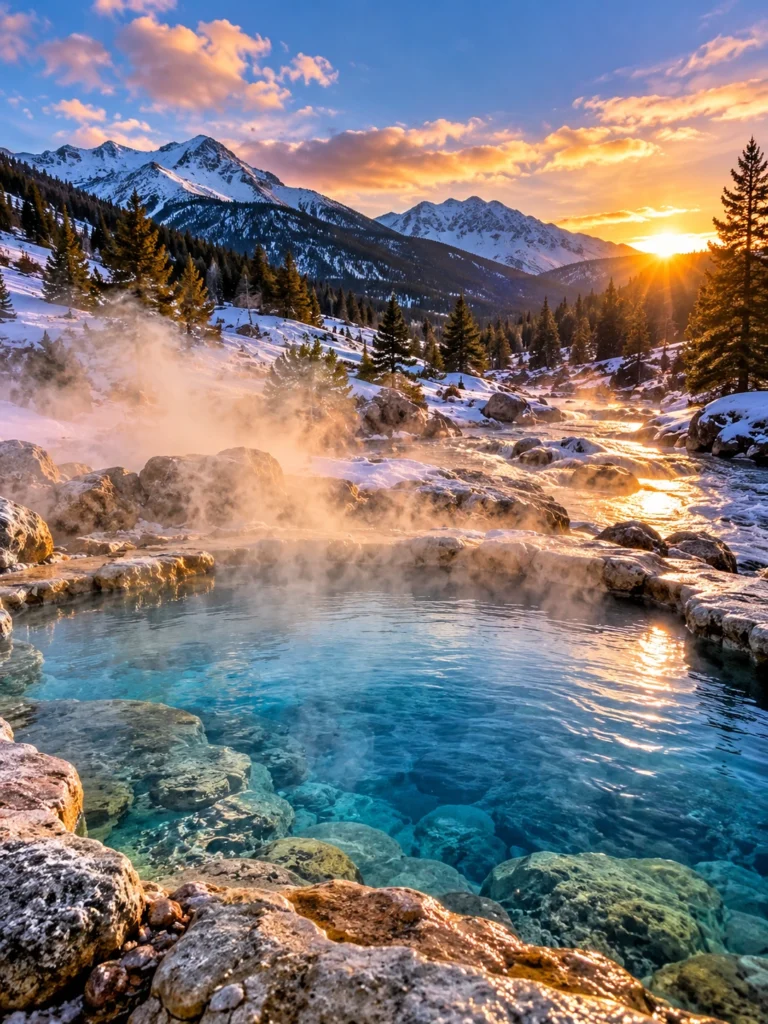
Colorado has so many hot springs because rain and snowmelt can seep into fractured mountain rock, travel deep enough to warm naturally, and then rise again along faults. Much of western Colorado has the steep terrain, underground heat, and connected cracks that make this possible. The result is warm water emerging beside rivers and beneath snow-covered peaks.
You can see these different settings at Glenwood Springs, Pagosa Springs, and Mount Princeton. They share a basic underground process, but their landscapes, mineral content, and visitor experiences are not identical. And despite Colorado’s volcanic past, most of its hot springs are not heated by active magma in the way Yellowstone’s are.
At a Glance
- Why Colorado has hot springs: Groundwater warms deep underground and returns through fractures in the rock.
- Where most are found: The western mountains and faulted valleys, including parts of the Rio Grande Rift.
- Geological count: 93 known thermal areas, including springs and wells, not 93 public soaking resorts.
- Three places to understand them: Glenwood Springs, Pagosa Springs, and the Mount Princeton area near Nathrop.
Why Western Colorado Has So Many Hot Springs
Colorado’s hot springs are not evenly scattered across the state. Many sit in mountain valleys west of the Front Range, where snowmelt supplies groundwater and fractured rock allows it to circulate deeply.
Underground heat flow is also generally more favorable here than on the eastern plains. But warmth alone is not enough. The water needs connected routes down and back up.
Faults provide some of those routes. The Rio Grande Rift, where the Earth’s crust has stretched and fractured, includes the Upper Arkansas and San Luis valleys. The San Juan Mountains farther southwest have their own geothermal settings.
That is why a spring may appear beside a creek or on a valley floor rather than on the snowy summit. The water can enter the ground high up and emerge much lower down.
How Does a Colorado Hot Spring Form?
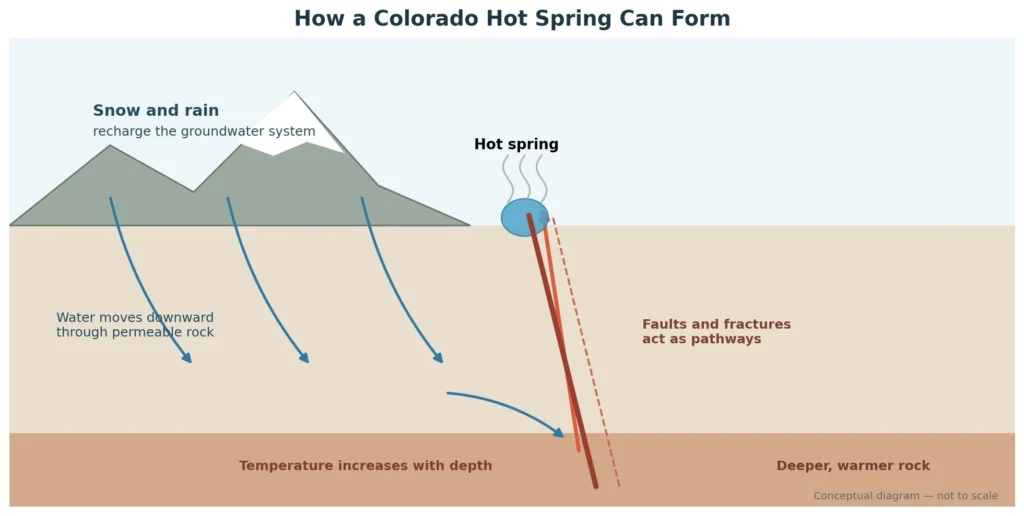
Follow a drop of melted snow:
- Water enters the ground. Rain and melting snow seep into soil, cracks, and permeable rock.
- It travels deeper. Connected fractures and differences in water pressure allow some groundwater to circulate far below the surface.
- Warm rock heats it. Underground temperatures generally rise with depth. Water absorbs that heat as it moves.
- It finds a route upward. Warm water rises through suitable fractures, sometimes mixing with cooler groundwater before reaching a spring.
This is why a spring can stay warm while snow falls around it. Its heat comes from beneath the mountains, not from the day’s weather. Nearby springs can still differ in temperature because their underground routes vary.
Three Colorado Hot-Spring Areas That Show the Difference
These three places show how Colorado’s underground geology shapes very different visits.
Glenwood Springs: A Hot Spring in a River Town
Glenwood Springs sits where the Colorado and Roaring Fork rivers meet. The town’s large soaking pool is developed, but the hot water feeding this area has a much older story.
The Ute people knew the spring as Yampah, often translated as big medicine. Its cultural significance predates the modern resort by generations.
Underground, the water passes through mineral-bearing rock, picking up dissolved substances along the way. Above ground, a soak fits easily beside river views and a drive through Glenwood Canyon. Managed pool temperatures may differ greatly from the natural source.
Pagosa Springs: Thermal Water Beside the San Juan River
In southwestern Colorado, Pagosa Springs brings thermal water to the banks of the San Juan River. The nearby San Juan Mountains make a scenic backdrop for a longer mountain trip.
Not all this water rises through one vertical crack. Some flows sideways through the Dakota aquifer, a water-bearing rock layer, while another portion rises toward the springs. Natural outlets and nearby wells can therefore be connected without behaving identically.
The river is part of Pagosa’s appeal, whether you choose a managed riverside pool or a walk along the water. Do not assume every warm-looking spot is a public bathing area.
Mount Princeton: Hot Water Below the Collegiate Peaks
Near Nathrop, south of Buena Vista, Mount Princeton rises above the Upper Arkansas Valley. The Collegiate Peaks provide the view, but fractured rock beneath the valley helps explain the hot water.
This is part of the northern Rio Grande Rift. Faults and fractures allow deep groundwater to circulate and return near the Chalk Creek corridor. It is a striking contrast: high peaks above, geothermal water below.
Here especially, do not treat a geothermal map as a swimming guide. Source water can be much hotter than managed pools, and creekside access may have different rules.
Are Colorado’s Hot Springs Volcanic Like Yellowstone?
Usually not. Colorado has ancient volcanic rocks, especially in the southwest. That does not mean active magma is heating its hot springs today.
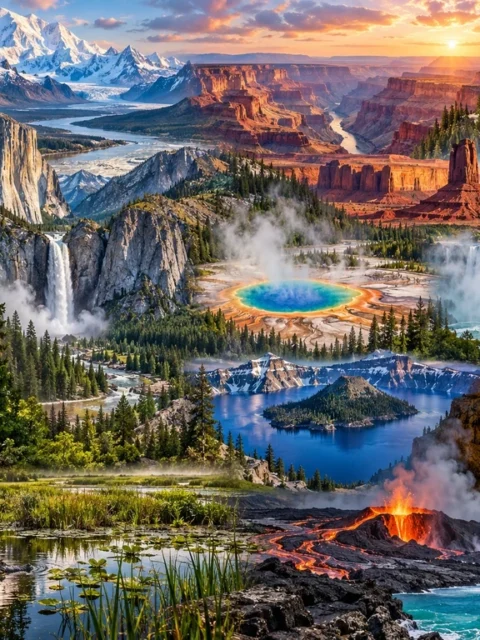
Colorado’s springs generally result from deep groundwater circulation. Yellowstone differs: the National Park Service explains that magma beneath the region supplies heat for its geysers and other hydrothermal features.
Yellowstone’s geysers help earn its place among our natural wonders in the US. Steam rising from a Colorado pool, however, is not evidence of a hidden active volcano.
Does Colorado Really Have 93 Hot Springs?
The Colorado Geological Survey identifies 93 known thermal areas, including natural springs, augmented natural springs, and wells. That does not mean 93 places are available for swimming.
The figure is consistent with a 1992–1993 state geothermal assessment, not a new 2026 count of visitor pools. One thermal area can contain several outlets; one resort may operate several pools fed by a single source.
A geological map cannot tell you whether a spring is safe to enter, open to visitors, or available without a booking.
Why Do Colorado Hot Springs Have Different Temperatures and Minerals?
One spring may draw from a deeper route, while another mixes with cooler groundwater before emerging. Their temperatures can differ even within the same valley.
Minerals from the surrounding rocks can affect smell, color, and deposits around an outlet. But minerals do not create the heat, and a strong mineral smell does not prove medical benefits.
What Travelers Should Know Before Visiting
The natural source and a visitor pool are two different things. Before setting out:
- Check access. Some thermal features are undeveloped, private, or restricted.
- Use designated soaking areas. Natural source water can be dangerously hot. A photograph cannot tell you it is safe.
- Verify current details. Pool hours, bookings, and age restrictions change. Start with the official Colorado hot-springs guide for developed destinations.
- Plan for mountain roads. Snow and ice can affect the drive even when a pool is open.
- Leave time for scenery. Colorado ranks among our most beautiful states in the US, and a soak pairs naturally with a mountain road trip.
The Bottom Line
Colorado’s hot springs start with mountain water traveling through warm rock and returning to daylight beside rivers and below rugged peaks.
Glenwood Springs, Pagosa Springs, and Mount Princeton show how varied that journey can be. Understanding the geology adds another layer to the scenery, and knowing which pools are managed makes the trip safer.
Colorado Hot Springs FAQs
Yes. Many developed facilities operate in winter. Check current hours and road conditions before traveling.
The geothermal water is natural, but visitor pools may direct, cool, or blend it for bathing.
No. The count includes wells and undeveloped springs. Access and safety conditions vary.