
A commercial airplane would theoretically take around 42 to 50 hours to fly around the world nonstop.
This estimate is based on Earth’s equatorial circumference of about 24,901 miles (40,075 km).
In reality, no commercial passenger flight circles the globe nonstop. Aircraft must account for fuel limitations, weather conditions, airspace restrictions, airport operations, and routing requirements. As a result, real-world round-the-world journeys usually take several days or even weeks rather than a couple of days.
While walking around the world could take years, modern aviation can theoretically reduce the journey to less than two days of continuous flight time.
Understanding the Distance around Earth
It has been some time since we knew that the Earth is not completely round; therefore, the distance can vary depending on where you measure it.
As said earlier, around the equator, the Earth is about 40,075 km / 24,901 miles wide in a full loop. However, we also know the circumference from pole to pole is a tad smaller i.e. 40,008 km / 24,860 miles. Well, the difference is small, but it is significant for precision planning and explains why a plane’s route is never a straight line on a map.
| Measurement Type | Distance |
| Equatorial Circumference | About 40,075 km |
| Polar Circumference | Around 40,008 km |
| Average Commercial Route | Varies |
To save fuel and time, airlines try to take the shortest practical path on a sphere, and that is the reason to follow great-circle routing. Seeing the globe, it is the shortest route between two points, but it looks curved and odd on a flat map.
How Long Would it Take to Fly around the World Nonstop?
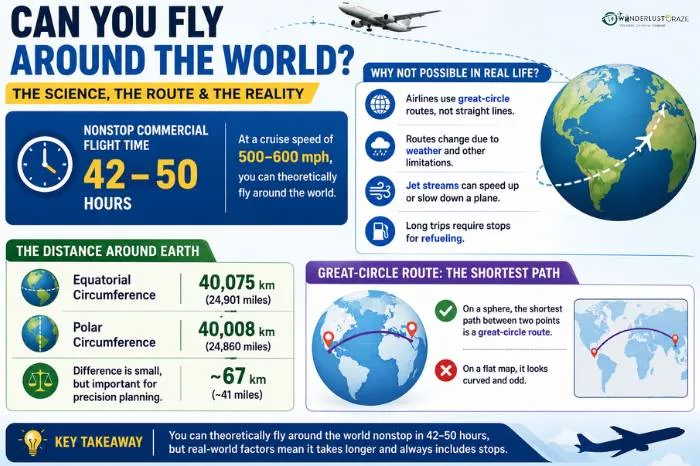
A normal commercial plane can fly in the range of around 500 to 600 mph or 800 to 965 km/h. If the plane keeps flying with such speeds (nonstop) around earth’s equatorial circumference, it should complete the trip in about 41.5 to 49.8 hours.
On the other hand, private jets (cruising at a speed of nearly 700 mph) can fly around the world nonstop in roughly 35 hours, whereas a fast military plane like Lockheed Martin F-22 (Fighter with a 1,500 mph speed) could do it in under 17 hours. That said, they both have their limitations in refueling and cannot travel as far as commercial planes.
These numbers give us a fair, theoretical idea how fast we can circle the earth, but in reality that is impossible. The figures above assume these aircraft have cruised steadily without any interruptions, which could never happen in normal travel. In addition, I also supposed clearest possible global route, which again cannot be followed in real life. Global air travel has to consider air traffic control, headwinds, refueling limits, airport operations, and other aspects.
| Aircraft Type | Average Speed | Estimated Nonstop Time Around Earth |
| Commercial Airliner | 500-600 mph | 42-50 hours |
| Fast Private Jet | 700 mph | 35.5 hours |
| Military Fighter Jet (F-22 Raptor) | 1,500 mph | 16.6 hours |
| Concorde | 1,350 mph | ~18 hours |
| Luxury RTW Journey | 500 to 550 mph | 6-7 weeks |
Why do Real Trips take Much Longer?
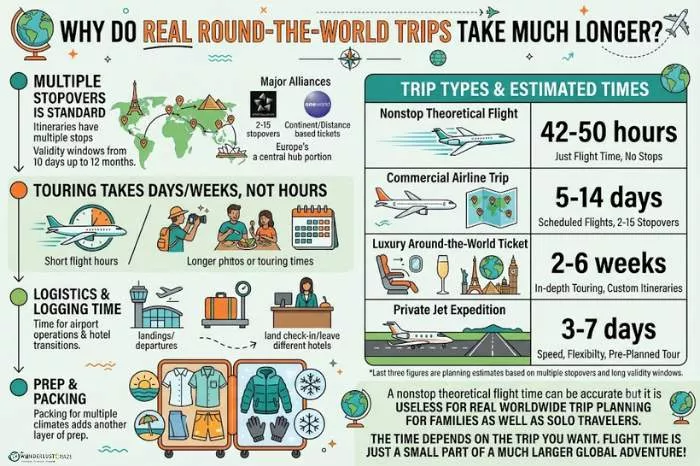
Round-the-world itineraries offered by major airline alliances have multiple stopovers in different continents. For instance, oneworld offers continent-based and distance-based tickets that mostly include a Europe travel itinerary for different cities as a central hub portion of the journey. Star Alliance allows you to design a round-the-world itinerary with 2 to 15 stopovers. The travel window is from 10 days up to 12 months after the first departure.
Therefore, the time to circle around the world depends on the trip you want. Of course, the flight time will be in hours, but touring different countries and continents will take days or weeks. You will be landing in and departing from different airports as well as checking in and leaving different hotels. Managing your suitcase packing for multiple climates adds another layer of prep to these long journeys.
A nonstop theoretical flight time can be accurate but it is useless for real worldwide trip planning for families as well as for solo travelers.
| Travel Type | Estimated Time |
| Nonstop Theoretical Flight | 42-50 hours |
| Commercial Airline Trip | 5-14 days |
| Luxury Around-the-World Ticket | 2-6 weeks |
| Private Jet Expedition | 3-7 days |
The last three figures for travel types above are planning estimates, based on multiple stopovers and long validity windows.
Fastest Verified Flights Around the World
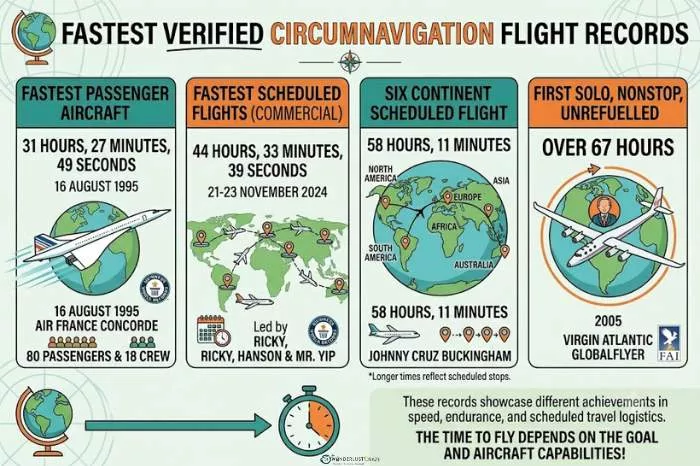
The fastest confirmed circumnavigation in a passenger aircraft took 31 hours, 27 minutes, 49 seconds on 16 August 1995. Guinness World Records acknowledges the aircraft used was the Air France Concorde, carrying 80 passengers and 18 crew members on board.
There is another Guinness World Record for the fastest circumnavigation by scheduled flights. The flights took 44 hours, 33 minutes, 39 seconds. Led by Ricky, Hanson, and Mr. Yip, the flight started on 21st November and ended on 23rd November 2024.
The third Guinness World Record, we know about, is for a six continent schedule flight completed by Johnny Cruz Buckingham. The flight took 58 hours, 11 minutes. The longer times here tell that these weren’t non-stop flights.
The last record worth mentioning is about the solo, nonstop, unrefuelled aircraft circumnavigation. Steve Fossett flew on the Virgin Atlantic GlobalFlyer and completed the flight around the world in only over 67 hours in 2005. FAI acknowledged this achievement as the first solo, nonstop, unrefuelled circumnavigation of the world in an airplane. Fossett made a number of other records, including an around-the-world speed record (551 kilometers/342 miles per hour), an absolute distance record, and a closed-course distance record over Salina.
What Changes the Time so Much?
Aircraft speed is the biggest factor that can reduce flight time to a destination, but when we have to wait for slots or change routes due to weather, the numbers change. A faster jet with poor connections will lose to a slower jet with better logistics.
Wind and jet streams play their role as well. Jet streams are strong bands of wind airplanes encounter while traveling from west to east generally. Eastbound aircraft get help from tailwinds, whereas westbound ones have to face headwinds that can prolong the journey.
Refueling stops are a necessity because every plane has a fuel capacity and its flight time depends on weather conditions and route. Considering these factors, an aircraft may have to stop even when the fuel is aplenty. According to the FAA’s aviation weather guidance, pilots should take into account upper air winds and turbulence on the flight. It is better for them to take a detour and pick a refuel stop instead of risking their lives for a nonstop flight.
Every flight needs a route design. Airplanes cannot necessarily take the shortest path because of airspace restrictions imposed by certain countries. This is the reason your planned route could be longer than what you calculate on a map. Aviation authorities have to optimize airplane routes considering safety, airspace access, aircraft’s fuel requirements, and connections to different destinations.
How Much does an Around the World Flight Ticket Cost?
I cannot give you a single price for an around-the-world (RTW) ticket because fares depend on factors such as the route, departure country, travel class, number of stopovers, and total distance flown.
For instance, oneworld offers RTW tickets in Economy, Business, and First, and British Airways fares depend on the number of continents you want to visit or the total distance flown. Besides, Star Alliance’s RTW design a tour around cities you like to visit.
According to a Wikivoyage, you have to pay in the low thousands of dollars for round the world trip in economy flights. On the other hand, Business and First Class flights may demand five figures. Whatever your budget is, my best travel suggestion for beginners is to book RTW tickets in advance to save cash.
Final answer
So, how long does it take to fly around the world? Well, a nonstop trip on a commercial jet would take about 42 to 50 hours, theoretically. Alternatively, a real passenger journey with stops will usually span days to weeks, depending on route design, airport timing, wind, weather, fuel limits, and connection planning. The fastest time for an aircraft to circle the globe is 31 hours, 27 minutes, 49 seconds.
The time to fly around the world is not simply a number; rather, it reminds us that the world is round, we do not have authority over all skies, and a trip that looks short on a map can be an adventure of a lifetime.
FAQs
Board on a commercial plane and take a trip around earth’s circumference at full speed, you might complete the journey in 42 to 50 hours.
It depends on the plane you choose and its maximum speed; a commercial flight at a speed of 600 mph could take 42 to 50 hours. A private jet with a speed of 700 mph will take about 35.5 hours. These figures are for nonstop flights, which are not possible yet.
According to Guinness World Records, the fastest a passenger aircraft completed this trip was in 31h 27m 49s. The scheduled flight record is 44h 33m 39s, made in 2024. For a solo nonstop unrefuelled flight, Steve Fossett completed the circle in just over 67 hours.
Unfortunately, we cannot give you a fixed price since fares vary according to the route you choose, the number of continents and cities you want to visit, and your desired cabin class for the travel. To give you an idea, it could be anything from low thousands to five figures.
Most commercial aircraft cannot fly around the world without refueling. Specialized aircraft such as the Virgin Atlantic GlobalFlyer completed a solo nonstop unrefuelled circumnavigation in 2005, but commercial passenger aircraft require fuel stops or route planning that involves multiple airports.
No. Even the fastest verified passenger aircraft circumnavigation took more than 31 hours. Current commercial aircraft are not capable of circling the Earth within 24 hours.
Earth’s equatorial circumference is approximately 24,901 miles (40,075 km). Aircraft following real-world routes may fly slightly more or less depending on weather, routing restrictions, and destination choices.
Military aircraft such as the F-22 Raptor have much higher top speeds than commercial airliners. However, fuel limitations mean that speed alone does not determine circumnavigation time.
No. No airline currently operates a commercial passenger flight that circles the Earth on a single nonstop route. Round-the-world trips are completed through multiple flights and airport connections.