
Does It Rain in Paris? Rainiest Months and What to Expect
Paris looks especially cinematic under grey skies, with wet pavements reflecting old façades and café lights. Still, travelers often wonder whether the romance comes with a practical problem: does it rain in Paris often enough to disrupt a holiday?
The answer is reassuring. Rain is a regular part of Parisian weather, but a shower rarely means you have to abandon your plans for the entire day. Knowing when precipitation is more likely, what the showers tend to feel like, and what to carry with you makes a rainy forecast much easier to handle.
Does It Rain in Paris?
Yes, it rains in Paris throughout the year, but Paris has no clearly defined rainy season. The city’s official tourism office describes rainfall as relatively spread across the calendar, with around 110 days of rain annually. Monthly rainfall varies, but there is no single stretch when visitors should expect constant wet weather.
Travelers should remember that Paris rainfall usually comes as manageable periods of showers rather than endless rain. May has the highest average rainfall in the current Paris je t’aime climate table at 69 mm, while December records 62 mm. January and February are considerably lower at 47.6 mm and 41.8 mm respectively.
Does It Rain a Lot in Paris?
Paris gets enough rain that an umbrella or waterproof outer layer deserves a place in your luggage, but calling the city exceptionally rainy would give travelers the wrong impression.
The current climate information from Paris je t’aime, the official Paris tourism office, describes precipitation as moderate and distributed through the year. Its figures give Paris around 110 rainy days annually, which works out to roughly nine days in an average month.
That annual figure needs some context. A “rainy day” in a climate record can involve a passing shower followed by several dry hours. It can also mean precipitation during a limited part of the day. You therefore should not picture 110 days of continuous rainfall.
This distinction is useful when planning sightseeing. A forecast calling for rain can still leave plenty of room for a morning walk along the Seine, an afternoon museum visit or dinner somewhere across town.
The bigger inconvenience tends to be timing rather than volume. A 30-minute shower arriving just as you reach the Eiffel Tower can feel far more disruptive than several brief showers separated by dry spells.
How Often Does It Rain in Paris?
With around 110 days of annual rain, Paris je t’aime describes Paris rainfall as moderate and relatively evenly distributed across the year.
In practical terms, that means rain can appear during almost any Paris trip. A three-day visit in July can encounter a shower just as easily as a December weekend can begin under wet skies.
The statistic becomes more useful when combined with the monthly figures. Paris averages less than 70 mm of rainfall in every month listed by the tourism office, with May reaching the annual high at 69 mm.
So, when you’re asking how often it rains in Paris, think regular but variable rather than constant. The weather can change during a single day, which is why checking the forecast shortly before heading out gives you a better picture than relying on the month alone.
What Is the Rainiest Month in Paris?
May is the rainiest month in Paris according to the current Paris je t’aime climate data, with average rainfall of 69 mm, while December is the second, with 62 mm.
May’s position can surprise travelers who associate spring with reliably dry sightseeing weather. Temperatures are pleasant, though, with the same source giving May average lows of 11.1°C and highs of 20.2°C. That combination can produce pleasant days interrupted by showers rather than a washout of the whole month.
For a May trip, a light waterproof layer makes more sense than changing your entire itinerary around the possibility of rain.
Paris Rainfall by Month
The table below uses the same current climate dataset published by Paris je t’aime, avoiding the confusion that can arise when different weather websites use different observation periods or calculation methods.
For the broader climate picture, weather in Paris by month pairs these rainfall figures with average highs, lows and typical conditions throughout the year.
| Month | Average Rainfall | Traveler Takeaway |
|---|---|---|
| January | 47.6 mm | Cool, occasional wet spells and damp days |
| February | 41.8 mm | One of the lighter months for rainfall, with chilly showers |
| March | 45.2 mm | Changeable spring weather with intermittent showers |
| April | 45.8 mm | Mild conditions with occasional rain |
| May | 69.0 mm | Wettest average month, often mixed with pleasant spring weather |
| June | 51.3 mm | Warm, generally manageable showers |
| July | 59.4 mm | Summer showers with occasional heavier bursts |
| August | 58.0 mm | Warm weather with showers and possible thunderstorms |
| September | 44.7 mm | Relatively light rainfall with changing autumn weather |
| October | 55.2 mm | Cooler, wetter-feeling days become more common |
| November | 54.3 mm | Damp autumn conditions and more frequent grey skies |
| December | 62.0 mm | Wet winter weather, often chilly and overcast |
Is There a Rainy Season in Paris?
No. Paris has no distinct rainy season.
Rainfall is spread across the calendar, although some months receive more precipitation than others. Paris je t’aime specifically describes the city’s rainfall as relatively evenly distributed, with a modest rise around May and June and another noticeable increase in December.
That pattern gives travelers more freedom when choosing dates. Someone visiting in summer still needs to allow for showers, while a spring or winter visitor cannot assume every day will be wet.
There is no single best time to visit Paris. Choosing travel dates around temperature, daylight, crowds and personal preferences can be more useful than trying to avoid one supposed wet season.
What Is Rain in Paris Actually Like?
Rain in Paris comes in several forms, and the difference can change how much it affects your day.
Brief showers are common enough to be worth preparing for. You might leave your hotel beneath cloudy skies, walk for half an hour under light rain and then find dry pavement before lunch.
Drizzle can be more irritating than a heavier shower because it hangs around. It may barely look dramatic, yet several hours of fine moisture can leave clothes and shoes noticeably damp.
There are also occasions when prolonged rain settles over the city. Those are the days when swapping an outdoor attraction for a museum makes practical sense.
During warmer months, summer thunderstorms can bring much heavier bursts over a shorter period. A calm afternoon can turn wet quickly, so checking the day’s forecast before a long outdoor excursion is worthwhile.
Rain can also become part of the Paris experience rather than simply interrupting it. Jeannine, who shared this summer rain moment with Wanderlust Craze, described it this way: “There’s something magical about waiting out a summer rain in Paris. Not only is it romantic, but when the rain stops, the clouds part, and the late-summer sun returns, everything glows. Paris looks newly rinsed, almost as if it’s been waiting all day for exactly this moment to show you Paris at its best.” — Jeannine, Paris traveler and creator
Winter has another character altogether. Damp air, wet streets and cooler temperatures can make a modest amount of rainfall feel colder than the number on the forecast suggests.
Paris je t’aime also advises checking detailed Météo-France forecasts when planning your stay, particularly for more current conditions.
Paris Rain by Season
Spring
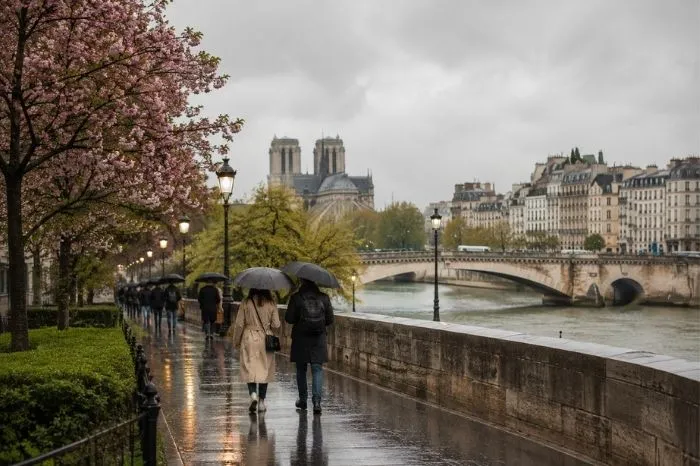
Spring is pleasantly changeable. March and April have comparatively moderate rainfall, while May is the wettest month by average precipitation. Mild temperatures can make a shower easier to deal with than the same weather in January.
Summer
Summer brings warmer days, yet rain remains part of the picture. July and August both record close to 60 mm of average rainfall, while thunderstorms can create short periods of much heavier rain.
Autumn
September witnesses the lowest monthly rainfall in Autumn at 44.7 mm. October and November become cooler and wetter, creating the damp autumn atmosphere many travelers associate with Paris.
Winter
Winter is cool rather than relentlessly wet. December carries the highest winter rainfall figure, while January and February are lower. You still have plenty of things to do in winter if you plan properly.
What to Do When It Rains in Paris

Rain can actually make a more flexible Paris itinerary useful. Rather than crossing half the city for one outdoor attraction during a downpour, keep a few nearby alternatives in mind.
Visit a major museum. The Louvre, Musée d’Orsay and other cultural institutions give you several hours indoors while still keeping the day firmly focused on Paris.
Explore Paris’s covered passages. The city has more than 20 surviving covered passages, many dating from the 19th century, with shops, cafés and small businesses beneath glass roofs. Passage des Panoramas, dating from 1799, is the oldest of them and remains one of the more atmospheric options when the weather turns wet. It also fits nicely into a day spent looking for the city’s less obvious corners, alongside other places featured in our guide to hidden gems in Paris
Spend an hour in a gallery or quiet café. A rainy afternoon gives you a reason to slow down rather than race between landmarks. Pick somewhere close to your next planned stop and let the shower pass.
Visit a church or historic interior. Paris has many remarkable religious buildings whose interiors provide shelter while still giving you something meaningful to see, whether you stop briefly or stay longer.
Reshape the day’s route. Put outdoor sightseeing into a dry window and keep an indoor attraction nearby as a fallback. This approach works particularly well when you build some breathing room into your Paris itinerary.
What to Pack for Rain in Paris

Your best defense against Paris rain is simple clothing that works in several types of weather.
Start with comfortable shoes that can handle wet pavements. Avoid taking brand-new footwear on a trip where you expect to walk several kilometres each day, since wet conditions make already uncomfortable shoes even less pleasant.
A light waterproof jacket is often more useful than carrying a heavy coat outside the colder months. It can go over a sweater in spring or autumn and remain easy to pack when the skies clear.
An umbrella takes little space and can save you from an inconvenient shower, particularly when you plan to walk between attractions. A compact model is easier to manage on crowded pavements.
Layers also give you more flexibility because rainfall can arrive alongside a drop in temperature. You should pack for Paris according to your travel plan.
Does Paris Get Rain or Snow in Winter?
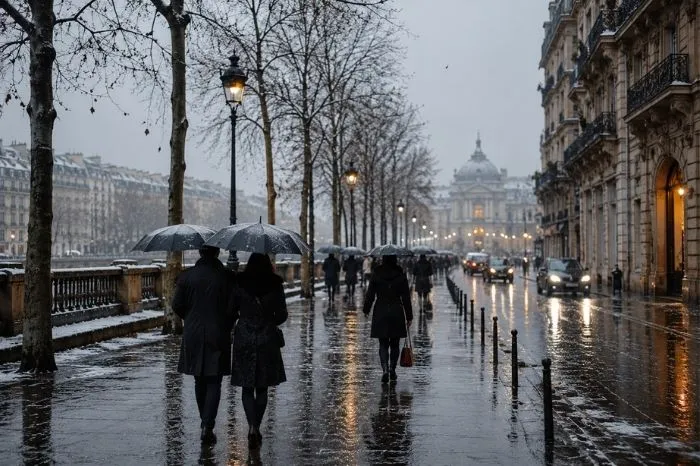
Rain and damp conditions are considerably more common for the typical Paris winter trip than significant, lasting snow. The city’s official climate figures put December rainfall at 62 mm, followed by 47.6 mm in January and 41.8 mm in February.
Does it snow in Paris? Yes, snow can certainly happen. Météo-France recorded 7 cm of snowfall at Paris-Montsouris, producing a 10 cm accumulated snow layer. The agency also noted that snow episodes in lowland areas are becoming less frequent in the context of climate change, although they have not disappeared.
Pack for chilly, damp days and take snow as a pleasant surprise if it happens.
Final Takeaway
So, does it rain in Paris? Absolutely, but the reality is gentler than the question may suggest. Paris has rainfall throughout the year, around 110 rainy days annually according to the city’s official tourism office, and no single rainy season that travelers need to avoid.
The smartest approach is to expect some changeable weather rather than build your trip around perfect sunshine. Pack footwear that can cope with wet streets, keep a light waterproof layer close, and leave enough flexibility in your sightseeing plans to move indoors when the sky turns against you. That way, even a rainy Paris day can remain very much part of the holiday rather than a lost day.
FAQs About Rain in Paris
Rain happens throughout the year instead of dumping all at once during a specific “rainy season.” Expect roughly 110 wet days annually, though many of those just bring quick showers rather than day-long downpours.
May receives 69 mm of rain, the most for any month in Paris. December follows at 62 mm.
No. Rainfall varies from day to day, and even a day recorded as rainy can contain only a short shower. The annual total should never be interpreted as a year filled with all-day rain.
Summer has regular rainfall, with averages of 51.3 mm in June, 59.4 mm in July and 58.0 mm in August in the current dataset. Warm weather and occasional thunderstorms can make summer showers quite different from winter drizzle.
Yes, December is one of the wettest months. Because it is also cold, packing a waterproof coat and water-resistant shoes is a smart move.
Paris has no distinct rainy season. Rain simply falls fairly evenly throughout the year.
Yes. A compact umbrella is a sensible item for any season, particularly if much of your sightseeing involves walking. It takes up little luggage space and gives you an easy option when a passing shower appears.