How Many Natural Lakes Are in Texas
Texas is enormous, crossed by rivers and dotted with thousands of places called lakes. Still, you may have heard one particularly surprising claim: Texas has only one natural lake.
It sounds almost impossible. How could a state covering more than 268,000 square miles have just one?
The truth is a little more interesting and a good deal more complicated than that familiar piece of Texas trivia.
At a Glance
There is no single statewide count that treats every naturally formed Texas waterbody under one definition. Texas Parks and Wildlife educational material often identifies Caddo Lake as the state’s only natural lake or only large naturally formed lake, while the Texas Water Development Board describes it as one of Texas’ few non-oxbow natural lakes. Texas also has naturally formed oxbows, resacas, playa lake wetlands and coastal lakes such as Green Lake.
So, Texas does not literally have only one naturally occurring lake-like waterbody. The answer depends on what is being counted as a “natural lake.”
How We Curate This Guide
Zaid Nawaz, our senior editor, reviewed how the Texas Water Development Board and Texas Parks and Wildlife Department classify Caddo Lake, reservoirs, oxbow lakes, resacas, playas and other naturally occurring waterbodies.
We found no current statewide agency inventory that counts all of these naturally formed waterbody types under one consistent definition. This guide therefore distinguishes the familiar “one natural lake” claim from the broader range of natural lakes and wetlands recognized by Texas agencies.
How Many Texas Lakes Are Naturally Occurring?
The most accurate answer is that Texas has several kinds of natural lakes, but no authoritative source gives one definitive statewide total for all of them.
If the question refers only to large, permanent, inland lakes that were not originally created by a dam, Caddo Lake is usually treated as the answer. It sits along the Texas-Louisiana border and is the state’s best-known naturally formed lake.
But if the definition includes smaller and sometimes seasonal waterbodies, the number becomes much larger. Texas naturally contains:
- Oxbow lakes
- Resacas
- Playa lakes
- Marsh lakes
- Coastal and tidal lakes
- Spring-fed and river-formed basins
The Texas Parks and Wildlife Department recognizes Caddo Lake as naturally occurring while also noting that playa lakes, marsh lakes, oxbows, and resacas occur naturally throughout the state.
That is why a bare answer of either “one” or “thousands” needs a little explanation.
Why Do People Say Texas Has Only One Natural Lake?
The claim usually refers to Caddo Lake, but it leaves several important words unsaid.
A more careful version would be:
Caddo Lake is commonly considered the only large or major natural lake in Texas.
That description separates it from the smaller oxbows, playas, resacas, and marsh lakes found elsewhere in the state. It also separates naturally formed lakes from the large reservoirs most Texans know today.
Over time, that longer explanation was shortened into the catchier statement that “Texas has only one natural lake.” It makes a memorable trivia answer, though it is not a complete account of the state’s natural waters.
Even official sources use slightly different wording. Texas Parks and Wildlife educational material has called Caddo the only naturally formed lake in Texas, while the Texas Water Development Board describes it more precisely as one of the state’s few non-oxbow natural lakes.
The difference comes down to classification rather than a mysterious lake disappearing from the map.
What Counts as a Natural Lake?
A natural lake forms through natural geological or hydrological processes rather than the deliberate construction of a dam or embankment.
Lakes can form when:
- A river changes course and leaves part of its old channel behind
- Rainwater gathers in a natural depression
- Coastal sediment separates a shallow basin from a bay
- Earth movement or debris blocks flowing water
- Groundwater or springs collect in a low-lying basin
The difficulty is that not every naturally filled depression looks like the broad, deep, permanent lake most people picture. Some Texas playas hold water only after heavy rain. Resacas may resemble narrow river channels. Oxbows can gradually fill with sediment or vegetation.
Scientists, state agencies, mapmakers, and ordinary travelers may therefore group these waters differently.
Caddo Lake: Texas’ Best-Known Natural Lake
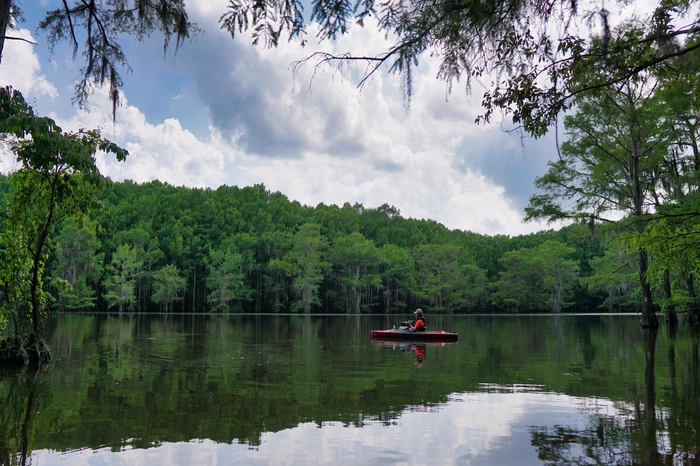
Caddo Lake lies in the forests and wetlands of East Texas, spreading across the Louisiana state line near Karnack and the wonderfully named town of Uncertain.
It does not look much like the wide-open reservoirs found elsewhere in Texas. Bald cypress trees rise from its dark water, their branches trailing curtains of Spanish moss. Bayous twist through patches of lily pads, and the quiet backwaters shelter fish, birds, turtles, alligators, and other wildlife.
The lake is believed to have developed when a massive accumulation of fallen trees and debris known as the Great Raft obstructed waterways connected to the Red River. Backed-up water spread into the surrounding lowlands and helped create the lake.
Its origin is natural, although people later changed it. A dam constructed in the early 20th century raised and regulated the water level. A modern replacement structure continues to influence the lake today.
This makes Caddo an interesting case: it began naturally but is now partly controlled by human engineering.
Quick Facts about Caddo Lake
| Fact | Details |
|---|---|
| Location | East Texas and northwestern Louisiana |
| Natural origin | Water backed up around a huge natural logjam |
| Present condition | Naturally formed but later altered and regulated by dams |
| Landscape | Bayous, wetlands, bald cypress forest, and open water |
| Known for | Paddling, fishing, wildlife, and hauntingly beautiful scenery |
Caddo feels worlds away from the bright, alpine waters that usually appear on lists of the clearest lakes in the United States. Its beauty is softer and moodier: a maze of shaded waterways where the forest seems to grow straight out of the lake.
Other Naturally Occurring Lakes in Texas
Caddo may receive most of the attention, but it is not the only Texas waterbody created by nature. The state’s other natural lakes tend to fall into several less familiar categories.
Oxbow Lakes
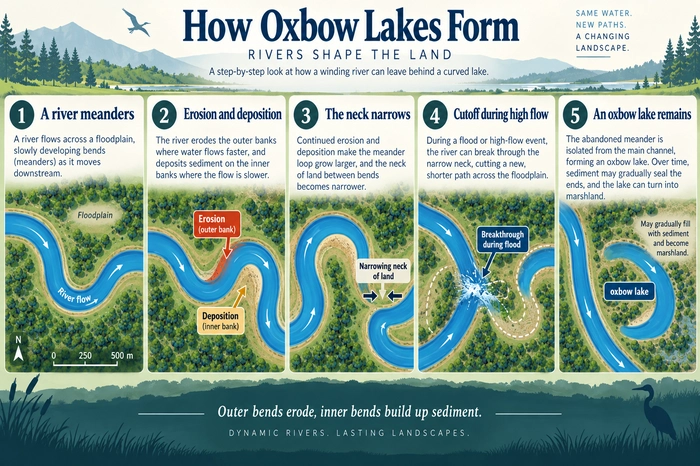
An oxbow lake forms when a looping bend in a river becomes separated from the main channel.
Rivers rarely stay perfectly still. They shift, erode their banks, deposit sediment, and sometimes take a shorter route across a narrow piece of land. The abandoned bend may remain filled with water, leaving behind a curved lake.
Texas has numerous oxbows along its rivers and floodplains, especially in the eastern and southeastern parts of the state. Many are small, shallow, privately surrounded, or known by local names rather than being promoted as major lakes.
Resacas
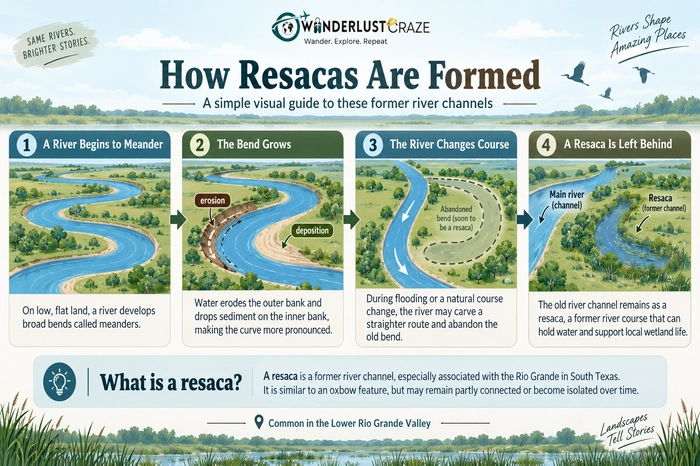
Resacas are abandoned channels of the Rio Grande found mainly in the Lower Rio Grande Valley.
They formed as the river shifted across its floodplain and left old curves behind. Some still hold water naturally, while others have been modified, connected, or managed for irrigation, drainage, wildlife habitat, and flood control.
Long and narrow, a resaca may look more like a sleepy river branch than a conventional lake. Hydrologically, however, many share the same basic origins as oxbow lakes.
Playa Lakes
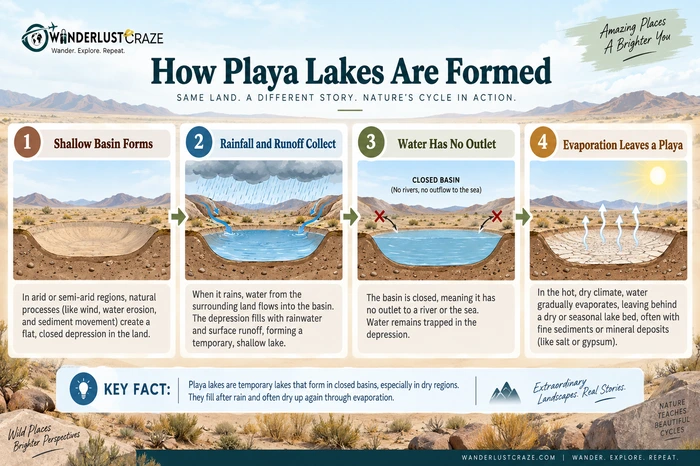
Scattered across the High Plains of West Texas are thousands of shallow natural depressions known as playas.
These basins collect rainwater and runoff, often appearing after storms and shrinking or drying during warmer periods. Their temporary nature does not make them unimportant. Playas provide valuable habitat for migratory birds and can help move water toward the Ogallala Aquifer.
Counting them is particularly difficult because their size and water coverage change with rainfall. One survey may count a visible pool, while another may classify the same place as a dry basin or seasonal wetland.
Marsh and Coastal Lakes
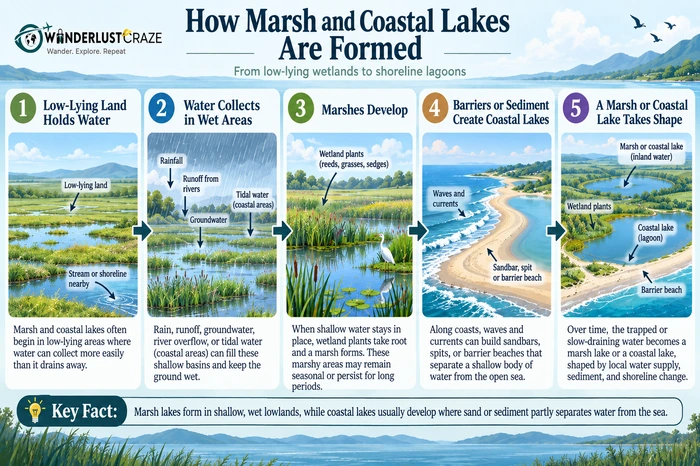
Texas’ Gulf Coast contains naturally formed marsh lakes, tidal lakes, and shallow basins shaped by sediment, rivers, storms, and changing coastal conditions.
Green Lake in Calhoun County is one notable example. It developed naturally on the coastal plain and is often described as one of Texas’ naturally formed coastal lake.
Coastal lakes can be difficult to categorize neatly because some remain connected to bays, wetlands, rivers, or tidal systems. They may be called lakes in one source and lagoons, marshes, or coastal basins in another.
Is Caddo Lake Really the Only Natural Lake in Texas?
No, not in the broadest sense.
Caddo Lake is not the only body of water in Texas that developed without people building a reservoir. Natural oxbows, resacas, playas, marsh lakes, and coastal lakes also exist.
It is fairer to describe Caddo as:
- Texas’ best-known natural lake
- Its only widely recognized large natural inland lake
- One of its few non-oxbow natural lakes
- Its only major natural lake, depending on the definition being used
Calling it the state’s only natural lake without any qualification turns a complicated geographical question into a slightly misleading factoid.
Why Are Most Large Texas Lakes Man-Made?
| Large Texas Lake | Type | Created By |
|---|---|---|
| Lake Texoma | Man-made reservoir | Denison Dam on the Red River |
| Lake Travis | Man-made reservoir | Mansfield Dam on the Colorado River |
| Lake Livingston | Man-made reservoir | Livingston Dam on the Trinity River |
| Possum Kingdom Lake | Man-made reservoir | Morris Sheppard Dam on the Brazos River |
| Canyon Lake | Man-made reservoir | Canyon Dam on the Guadalupe River |
| Lake Conroe | Man-made reservoir | Dam on the West Fork of the San Jacinto River |
| Toledo Bend Reservoir | Man-made reservoir | Dam on the Sabine River |
Texas has relatively few large natural lake basins because its landscape was not shaped by the widespread glaciation that carved so many deep lakes across northern states.
Michigan, Minnesota, Wisconsin, and parts of New England were once covered by vast ice sheets. As those glaciers moved and melted, they gouged depressions into the ground and left countless basins behind. That glacial history helps explain the abundance of naturally formed waters found among the cleanest lakes in Michigan.
Texas developed under different conditions. It has broad plains, river valleys, dry western landscapes, and a long Gulf Coast, but relatively few naturally enclosed basins capable of holding enormous permanent lakes.
At the same time, the state needed dependable water supplies for growing cities, farms, industries, and flood control. Rivers were dammed throughout the 20th century, creating the reservoirs now familiar to residents and travelers.
According to Texas Parks and Wildlife, the state has more than 200 major reservoirs and thousands of smaller ones. These man-made lakes supply water while also supporting fishing, boating, swimming, camping, and lakeside communities.
Are Famous Texas Lakes Natural or Man-Made?
Most of the large recreational lakes Texans visit are reservoirs rather than naturally formed lakes.
| Lake | Natural or Man-Made? | How It Formed |
|---|---|---|
| Caddo Lake | Natural origin, later modified | Formed around a natural logjam and later regulated by dams |
| Lake Texoma | Man-made | Created by Denison Dam on the Red River |
| Lake Travis | Man-made | Created by Mansfield Dam on the Colorado River |
| Lake Livingston | Man-made | Created by Livingston Dam on the Trinity River |
| Possum Kingdom Lake | Man-made | Created by Morris Sheppard Dam on the Brazos River |
| Canyon Lake | Man-made | Created by Canyon Dam on the Guadalupe River |
| Lake Conroe | Man-made | Created by a dam on the West Fork of the San Jacinto River |
| Toledo Bend Reservoir | Man-made | Created by a dam on the Sabine River |
Being man-made does not make these lakes any less scenic or enjoyable. Several have clear water, wooded shorelines, rocky coves, and views that help Texas stand proudly among the most beautiful states in America.
The distinction simply tells us how the basin came to exist.
Why the Exact Number is so Hard to Calculate
Anyone hoping for one tidy statewide total runs into several problems.
Definitions vary
Some counts include seasonal playas and tiny oxbows. Others count only named, permanent lakes above a certain surface area.
Water levels change
Playas, marshes, and floodplain lakes can expand after rain and disappear during drought. Two surveys taken in different years may produce very different totals.
Natural lakes can be modified
A naturally formed waterbody may later be deepened, connected to canals, surrounded by levees, or regulated by a dam. Caddo Lake itself illustrates how difficult the natural-versus-man-made divide can become.
Names do not always match geography
A place called a lake may actually be a reservoir, lagoon, widened river, or marsh. Meanwhile, a naturally occurring lake may be locally described as a pond, resaca, bayou, or wetland.
Small waterbodies are not always cataloged consistently
Large reservoirs receive detailed monitoring because they provide drinking water and flood protection. Small private oxbows or temporary playas may receive far less attention.
Frequently Asked Questions
No authoritative agency provides one definitive count covering every type of natural lake. Caddo Lake is commonly considered Texas’ only major natural lake, while many smaller oxbows, resacas, playas, marsh lakes, and coastal lakes also formed naturally.
Caddo Lake is commonly called the only natural lake in Texas. More precisely, it is the state’s best-known large natural lake and one of its few non-oxbow natural lakes.
Caddo Lake formed naturally, probably because a massive logjam backed water into low-lying land. Dams later raised and regulated its water level, so the modern lake is naturally formed but human-modified.
That depends on the definition. A very broad count may include thousands of small or seasonal playas, oxbows, resacas, marshes, and similar waterbodies. However, there is no widely cited authoritative total confirming that Texas has thousands of permanent natural lakes in the ordinary sense.
Caddo Lake is widely regarded as Texas’ largest major natural inland lake. Sabine Lake is larger and touches the Texas border, but it is an estuary connected to the Gulf of Mexico rather than a conventional inland freshwater lake.
Yes. Green Lake in Calhoun County is a naturally formed coastal lake and is often identified as one of the substantial naturally formed coastal lakes located entirely within Texas.
No. Lake Travis is a reservoir created when Mansfield Dam was built across the Colorado River. It is one of the best-known recreational lakes in Central Texas, but its basin is man-made.
There is no simple official percentage covering every pond, playa, oxbow, and reservoir. However, nearly all of the state’s large, familiar recreational lakes are man-made reservoirs.
Texas was not extensively carved by Ice Age glaciers, which created countless deep lake basins in northern parts of the United States. The state’s climate and geology instead produced rivers, playas, oxbows, coastal wetlands, and only a small number of large natural lakes.