Ancient Wonders, Modern List: Exploring the New Seven Wonders
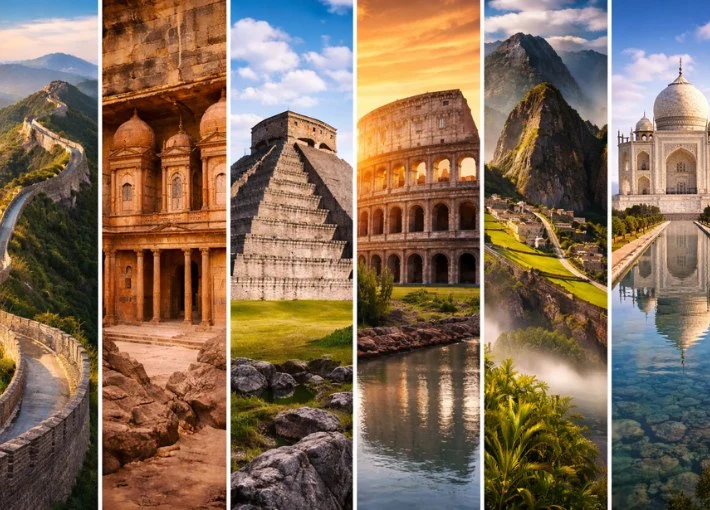
Are you familiar with the Seven Wonders of the World?
In 1572, Dutch engraver Philips Galle published a series of his engravings titled Octo Mundi Miracula, based on drawings by fellow Dutch artist Maarten van Heemskerck. The exquisite renderings of seven extraordinary sights from around the world, accompanied by poetic couplet descriptions, would become a definitive record of The Seven Wonders of the Ancient World.
Now, Heemskerck and Galle had pulled their list from that of Spaniard Pedro Mejía, who himself had said there was no real consensus on which wondrous sights were the very most wondrous, because travelers from all cultures had their own ideas. Nonetheless, the world at large has accepted the Octo Mundi Miracula as the canonical list for centuries, though the sad fact is that of those original seven wonders, only the Great Pyramid of Giza remains.
In the intervening centuries, new and ever more wondrous structures have sprung up around the world, and many Wonders lists have resulted; there are lists of everything from Natural Wonders to Wonders of the Medieval World. And thanks to a public vote in 2007, we now have a list called the New Seven Wonders of the World as well.
The Seven ManmadeWonders of the World
| The Wonder | The Location | The Origin Year | The Annual Visits |
| The Great Wall of China | China, Multiple Sites | Est. 3rd century BC | Est. 10 million |
| The City of Petra | Jordan | Est. 5th century BC. | Est. 1 million |
| Chichén Itzá | Yucatán, Mexico | Est. AD 455 | Est. 2.2 million |
| The Colosseum | Rome, Italy | Completed AD 80 | Est. 15 million |
| Machu Picchu | Urubamba Province, Peru | Est. AD 1450 | Est. 1.6 million |
| The Taj Mahal | Agra, India | Completed 1648 | Est. 7.5 million |
| Christ the Redeemer | Rio de Janeiro, Brazil | Completed 1931 | Est. 2 million |
1. Great Wall of China

Built across what we now know as China over the course of fourteen centuries, the remnants of the Great Wall of China are a testament to endurance. The very largest man-made object in the world, the Wall stretches across over thousands of miles of today’s China, and exists because Emperor Qin Shi Huang first united multiple warring kingdoms and tribes into a single nation, and then took all of the fortifications scattered across these lands and began to link them together into a long, sturdy defensive wall.
An enduring marvel of ancient China’s legendary military architectural feats, the Wall is constructed from diverse materials, everything from thick walls of firmly rammed earth, wooden structures, and marble blocks helping to make up the various united sections of it. Parts of the Wall still exist not only in the rural areas most people see in photos, but even in the capital city of Beijing. Its unique purpose, construction, origins, and the myths that surround it–it cannot actually be easily seen from space!–have truly cemented its status as a World Wonder.
2. Petra, Jordan

There is no wonder quite like the carved city of Petra, in Jordan. Centuries ago, ancient Nabataen nomads looking for somewhere to settle down chose to carve elaborate structures into miles of rosy-hued sandstone. And they are elaborate; absolutely beautifully rendered building facades stand out in strong relief, some looking almost as if they are independent structures on their own.
The rock wall buildings of Petra have been determined mostly to be temples, tombs, and public gathering spaces. They were designed with a heavy Hellenic influence; unsurprising, given that Petra existed at the same time as the great city of Alexandria. Many buildings are decorated with carefully carved motifs and even statues, and inside–though these areas are generally not open to the public–there are huge rooms carved out of the rock. All in all, an absolutely jaw-dropping feat of rock carving, given that this was so many centuries before power tools!
Of the structures still standing today, Al Khazna (The Treasury) is the most well preserved and the most impressive. Goddesses, winged griffons, and vases decorate the imposing facade of Al Khazna, which has been discovered to be the final resting place of at least three royal personages.
3. Chichén Itzá

One of the greatest remnants of the incredible Mayan empire of pre-Hispanic North America may well be what remains of the city of Chichén Itzá.
Chichén Itzá was once one of the largest Mayan cities, with a thriving and diverse population, and it lasted for a thousand years before dwindling and declining. But before that decline, incredible Mayan-Toltec buildings and structures were constructed, such as the Caracol observatory with its spiral staircase, the grimly beautiful Tzompantli platform with its intricate skull carvings, and the Grand Ballcourt, where a largely unknown game was played with a rubber ball and where the acoustics allow visitors to stand at either end of the 460 foot court and speak to each other.
The most iconic site within Chichén Itzá is the great El Castillo, or the Pyramid of Kulkulkán. This 100 foot pyramid topped with a temple to the feathered serpent deity Kulkulkán (perhaps more well-known by his Aztec name of Quetzalcoatl) is a terraced structure with long, wide stone staircases on each of its four sides, leading to the temple. It is a deceptively simple-looking structure given how elaborate the Mayans tended to be with their architecture, but it’s not without its clever features; during the spring and autumn equinoxes, the afternoon sun and the terraces of the pyramid cause serpentine shadows to undulate along the balustrades of the staircases.
4. The Colosseum

In central Rome, the world’s largest standing amphitheater has stood watch over the city since very, very ancient times. Once the centerpiece in a swath of marshland, the Colosseum–known more formally as the Flavian Amphitheater–is now the heart of the bustling, thriving Italian capital, surrounded by modernity on all sides.
Construction on what we now know as the Colosseum began somewhere around 72 AD, and would be completed in 80; it was commissioned by the emperor Vespacian, who would not live to see his masterwork finished. It had been built to restore morale to a city destroyed and demoralized by repeated sieges and fires and other disasters, and possibly to trample a bit on the memory of despotic former emperor Nero–the Colosseum is built on the remains of Nero’s grand palace, which may or may not have been a very deliberate choice.
The Colosseum was originally used to host gladiatorial battles and animal hunts, but would evolve over the many centuries of its existence, serving in turns as housing, as a cemetery, as workshops, and of course continuing as an event venue. Today, it is in less than ideal shape for event hosting, but millions of visitors continue to flock to it as a living museum, to marvel at it as the enduring feat of Roman architecture that it is. And, did you know? It’s also home to a well-cared-for colony of Roman cats.
5. Machu Picchu

In remotest Peru, at 8,000 feet above sea level amidst the peaks and slopes of the Andes mountains, the ruined citadel of Machu Picchu stands majestic in all its ancient Incan glory.
Why Machu Picchu was built, what purpose it served, no one is quite sure. Many myths and legends persist–that it was a royal estate, that it was a religious sanctuary, that it acted as a prison, that it was a complete if small city. Whatever it was meant to be, it’s so skillfully constructed using perfectly cut rocks fit together without mortar, that it almost appears to have simply manifested out of the very rocks of the mountains themselves. A multi-layered enclave with dozens of structures connected by hundreds of steps, Machu Picchu is remarkably well preserved thanks to centuries of simply being unknown to the world at large. The whole site is carpeted in verdant green moss and surrounded by more lush vegetation and incredible views.
Machu Picchu was abandoned for reasons unknown before being rediscovered by Hiram Bingham III in 1911. Today, intrepid explorers visit the mountain citadel in droves, making it almost as alive as it would have been in the 15th century.
6. Taj Mahal

In Agra, India, there once lived an emperor who so loved his wife that, when she died at only 38 after the birth of her 14th child, the grief-stricken monarch spent the next two decades and more building what would become the world’s most beautiful and famous tomb: the Taj Mahal.
Emperor Shah Jahan’s exquisite memorial to his beloved Mumtaz Mahal is constructed from stunning white marble, surrounded by auxiliary buildings made of red sandstone that makes the bright, clear white of the main mausoleum stand out even more. It was designed in a blend of Mughal and Indo-Islamic architectural styles and decked out with semi-precious gemstones, fine marble reliefs, and intricate Arabic carvings. The Taj Mahal’s minarets and onion domes are its defining, most iconic features, however, instantly recognizable worldwide. These features and the draw they have on millions of visitors annually made the memorial’s inclusion on the Modern Wonders list a no-brainer.
7. Christ the Redeemer

Towering over Rio de Janeiro at an astonishing 98 feet (about nine stories!), Paul Landowski and Heitor da Silva Costa’s Christ the Redeemer statue stands arms wide, welcoming two million pilgrims to His feet every year.
The statue had humble beginnings, springing initially from a proposal made by a priest named Pedro Maria Boss sometime in the 1850’s. This proposal was rejected, but the seed of the idea was planted, and eventually the Catholic Circle of Rio worked to raise funds to make the statue a reality. Constructed from reinforced concrete and durable carved soapstone, the statue took nine years to build and stands at the peak of Corcovado Mountain. This makes visiting the statue a real pilgrimage, as even with escalators and elevators, it’s a fairly tedious hike up.
In the near-century of its existence, the statue has become a true icon, not only to Christianity but world culture in general; Olympic jerseys were cleverly light projected onto it for the 2016 Games, and when Taylor Swift brought her Eras tour to Rio, a projection of a t-shirt resembling her signature Junior Jewels t-shirt from her Fearless era made for whimsical decor. All a bit flippant, perhaps, but the statue remains a true wonder in every sense of the word, and an enduring symbol of faith.
The Seven Natural Wonders of the World
| Natural Wonder | Location | Key Fact/Figure |
| Mount Everest | Nepal / China | Highest peak on Earth is at 29,031.7 feet (8,848.86 m). |
| Great Barrier Reef | Australia | World’s largest coral reef, spanning over 1,400 miles (2,300 km). |
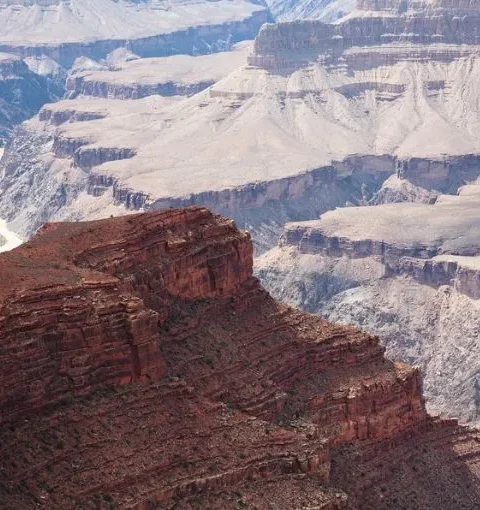
| Grand Canyon | USA (Arizona) | Roughly 277 miles (446 km) long and over a mile deep. |
| Victoria Falls | Zambia / Zimbabwe | Largest waterfall by sheet of water, 1,708 meters (5,604feet) wide. |
| Northern Lights | Arctic Regions | Natural light display from solar particles hitting Earth’s magnetic field. |
| Parícutin Volcano | Mexico | Cinder cone volcano that grew from a cornfield starting in 1943. |
| Harbour of Rio de Janeiro | Brazil | World’s largest natural deep-water bay by volume. |
Seven Wonders
Though very different from the Natural Seven Wonders of the World, the Modern Manmade Seven Wonders of the World are no less interesting, significant, and remarkable as their predecessors. They stand as memorials to perhaps more innovative times and as reminders of what sort of lasting legacies the human mind and body can create.
And yet, the planet itself has been quietly out-building us all along. The Seven Natural Wonders of the World are proof that, for all our ambition, nature has always had the more spectacular imagination.
Have you been to any of the Manmade or Natural Seven Wonders? Do you agree these are wondrous or would you put something else on the list?
Also Read: Most Iconic Landmarks in Ireland!